
A/B testing framework: A practical guide to scaling experimentation
Good test ideas aren't the problem. Acting on them consistently is. Here's how to turn A/B testing into a system that keeps compounding, instead of stalling the moment things get busy.






Published August 31, 2026

Most businesses don't run out of test ideas. They run out of time to act on them, or lose track of which ones were worth running in the first place. A single test here and there can still produce a win, but it won't add up to much on its own.
An A/B testing framework turns testing from something you do occasionally into something that keeps producing results, month after month, without depending on someone remembering to run the next one.
Key takeaways
- A framework turns testing into an ongoing process, not something you only do when someone has a good idea.
- Every day your traffic doesn't see a test is a day you didn't learn anything from it.
- Prioritize tests by weighing the effort against the potential payoff, not by picking whatever's easiest.
- A framework is working when results keep compounding over time, not just when you're running a lot of tests.
What is an A/B testing framework?
An A/B testing framework is a repeatable system for deciding what to test, in what order, and how to judge the result, rather than testing whatever idea comes up that week.
What an A/B testing framework looks like in practice
- A ranked backlog: 15 to 20 test ideas ranked by expected revenue impact, so when one test ends, the next is already queued up instead of brainstormed from scratch.
- A steady launch schedule: A new test launching every one to two weeks on a page with enough traffic, rather than waiting weeks after a test ends to decide what comes next.
- A simple scoring system: Rating each idea 1 to 10 on effort and expected impact, so a checkout redesign and a headline change can be compared on the same scale.
- A realistic annual target: A mature testing program aims for a combined conversion uplift of more than 30% a year, a number that only comes from testing continuously, not from a handful of wins scattered across the year.
This sits within a broader conversion rate optimization (CRO) strategy. A framework organizes the testing itself; the wider CRO process still covers research, design, and everything else that feeds into good test ideas.
Why you need an A/B testing framework
A single test can produce a good result, but that's not the same as having a testing program. A framework is what keeps tests running consistently, rather than depending on someone remembering to launch the next one.
If you have traffic coming to your website, any moment that traffic doesn't see a test is a lost moment for learning and improving conversions. If you're getting traffic but not testing, you're losing money. — Tom Amitay, CEO at CROforce
Tom Amita , CEO at CROforce
Benefits of having an A/B testing framework
- Higher testing velocity: A ready backlog means the next test can launch the moment the last one ends, instead of losing days or weeks deciding what to do next.
- Easier prioritization: Scoring every idea on the same scale removes the guesswork of choosing between a quick copy tweak and a bigger redesign.
- Scalability: A documented process can run across more pages and more people without depending on one person remembering what's already been tried.
- Compounding results: Consistent testing turns individual wins into a growing, combined uplift over time, rather than a handful of unrelated wins scattered across the year.
How to build a scalable A/B testing framework
A working framework runs through five stages, each feeding into the next.
Stage 1: Data foundations
Before you can come up with a good test idea, you need the data to base it on:
- Analytics data: What visitors are actually doing on your site or app right now.
- Conversion goals: Clearly defined actions you're trying to improve, not just "more conversions" in general.
- Brand and business context: What you sell, who you sell it to, and what makes your offer different.
- Competitive context: What similar businesses are doing, and how their sites have changed over time.
Stage 2: Hypothesis and test list
Turn that data into a hypothesis: a specific, testable statement about what could move a conversion goal, and why.
For example: "Simplifying checkout from three steps to one will reduce cart abandonment, because checkout is where the funnel loses the most people."
From there, build a list of tests that could prove or disprove it. A few things make that list worth acting on:
- Go beyond the obvious: Button colors and copy tweaks are easy to test, but they rarely move website conversion rate enough to matter.
- Aim for structural changes: The tests worth prioritizing usually mean changing something bigger, like a page layout, a checkout step, or a full section of a funnel.
- Tie each idea to a specific page: Whether that's a broader push on landing page conversion or a narrower funnel step.
- Write it like a brief, not a wishlist: A good test list reads like something you could hand to a developer, with a clear change and a clear expected outcome, not just a vague idea.
» Still testing based on gut feel? Here's what a structured approach to A/B testing a website looks like
Stage 3: Prioritization
Once the test list is longer than you can act on, which happens fast, you need a consistent way to decide what goes first.
The number one thing to look at is effort versus potential uplift. If a test takes a lot of work but the potential payoff is low, it doesn't make sense to prioritize it.
Tom Amitay , CEO at CROforce
This is the same logic behind more formal scoring methods experimentation teams use, like ICE (impact, confidence, ease) and PIE (potential, importance, ease). Both work the same way. Score each idea on how much it could move the needle and how easy it is to build, then work down the list in order.
You don't need the exact framework to get the benefit. The point is having any consistent way to compare a quick copy test against a bigger redesign, rather than defaulting to whichever one feels easiest that week.
Stage 4: Testing schedule
Tests need to launch on a steady schedule, ideally one new test every week or two on any page with enough traffic, rather than whenever someone happens to have time.
Running tests back-to-back, instead of leaving gaps between them, is often the single biggest factor in whether a framework produces a compounding uplift or just a handful of occasional wins.
A few rules keep that pace from causing problems:
- Stagger tests that share a page: Two tests touching the same page, or the same funnel step, at the same time can skew each other's results.
- Split overlapping tests across separate traffic segments: Do this if two tests need to run at the same time.
- Give every test enough traffic to reach statistical significance: Don't call a test early just because volume is high and there's pressure to move to the next one.
» Keeping to a schedule depends on how fast you can build. Try CROforce's AI test builder to launch tests faster.
Stage 5: Review and documentation
Every test needs a clear verdict, not just a pass or fail. A useful review covers a few things:
- The result: Did it reach significance, and did it win, lose, or land somewhere inconclusive?
- The reason: If it's a form redesign, was the lift driven by fewer fields or a clearer layout? If it's a pricing change, did revenue per visitor move, or just conversion rate on its own?
- The next step: Does the result point to a follow-up test on the same page, or rule out that direction entirely?
Log all three in a shared place the whole team can search back through, like a spreadsheet or a dedicated test log, not someone's inbox or a private notebook. Six months from now, that record is what stops someone from re-running a headline test that already failed, or missing that the last three winning tests all involved simplifying a form.
» Looking to scale your testing framework? See the best A/B testing tools to support it.
Common mistakes when building an A/B testing framework
Test count and win rate are easy to track, but they don't tell you much on their own. A team can run dozens of tests a month and still not move the needle if most of those tests are small and safe. A better measure is whether results add up over time, not just whether individual tests occasionally win.
That gap between busy and effective usually comes down to a few recurring mistakes:
- No way to prioritize: Test ideas get chosen based on whoever's loudest or whatever's easiest to build that week, rather than a consistent way to compare potential impact.
- Defaulting to easy tests over higher-value ones: Button colors and copy tweaks get prioritized because they're quick, while bigger tests that take more investment but offer a much larger potential payoff keep getting pushed down the list.
- Underestimating the resources a backlog needs: A well-prioritized list of high-potential ideas still stalls without enough design and development capacity to actually build them.
- A losing test gets abandoned without a second look: A top-line loss can hide a real win in one segment. When CROforce ran a homepage test for kGoal, the overall result looked like a clear loss. Splitting the data by device told a different story: an 18% conversion lift and a 26% jump in revenue per visitor on desktop, dragged down by a weaker mobile experience. Checking only the average would have thrown that win away.
» See the A/B testing mistakes that break a testing framework
How CROforce approaches A/B testing frameworks
CROforce runs on the same framework described in this article, for its own work and for clients. Our framework has three moving parts: a live backlog of test ideas prioritized by effort against potential uplift, a dedicated team of CRO experts who build and monitor each test, and a sequencing process that turns individual wins into compounding results.
Case study: How CROforce's framework keeps growing Anchor's revenue
With a solid A/B testing framework, every test builds on the one before it, and results start to compound. Our testing strategy for Anchor's homepage shows exactly what that looks like in practice.
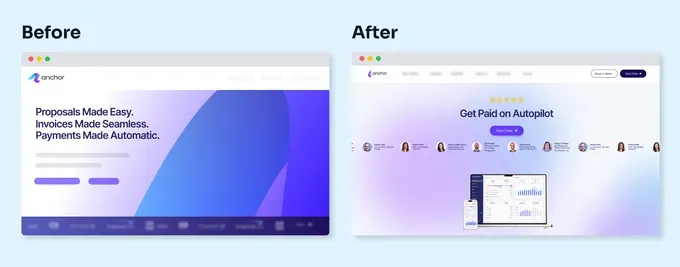
Here's the framework in action, step by step:
- Identify the leverage point: Traffic and conversion data pointed to Anchor's homepage as the page most likely to move the needle, so that's where the team focused first.
- Set the goal: Anchor was shifting toward a product-led growth motion, which shaped what "converting better" actually meant and shaped every hypothesis that followed.
- Develop hypotheses: Each test targeted the page's highest-impact elements in order: first the above-the-fold layout, then the copy and design, then the CTA.
- Run and iterate: Tests ran one after another instead of all at once. Each winner became the new control, and the next test launched within days of the last result.
- Analyze: A CRO specialist reviewed each result, while the platform determined the winner based on statistical significance.
The result: Three consecutive wins that compounded into a 132% lift in conversion rate and $11,000 in additional monthly revenue, over $133,000 a year, with each test building on the one before it rather than standing alone.
What this means for your own framework
- Prioritization needs to be a habit: The backlog gets rescored as new data comes in, not set once and forgotten.
- Capacity is usually the real constraint: Most businesses have more good test ideas than they have the design and development time to build them.
- Compounding comes from sequencing: Anchor's result came from three tests building on each other, not one test that happened to perform well.
» Don't have the capacity to build and run this yourself? See how CROforce's A/B testing service handles the whole backlog for you
Make testing a habit, not an event
A testing framework turns testing into a habit instead of an occasional event. The specific stages matter less than you'd think. What matters is whether the whole cycle keeps running: prioritizing an idea, testing it, reviewing what happened, then doing it again. That's what turns a handful of good ideas into a business that gets a little better every week.
FAQs
What is an A/B testing framework?
It's a repeatable system for deciding what to test, in what order, and how to judge each result, rather than testing only when a good idea happens to come up.
How is a framework different from just running tests?
Running tests on their own means starting from scratch each time. A framework keeps a running backlog of ideas, a consistent way to prioritize them, and a steady schedule for launching them.
How do you prioritize A/B tests?
Weigh how much work each test takes against how much it could realistically improve results. Frameworks like ICE and PIE formalize this, but the underlying idea is simple: don't spend a lot of effort on a test with a small potential payoff.
How many A/B tests should you run at once?
As many as your traffic and capacity can support without tests interfering with each other. Tests that touch the same page or funnel step should be staggered or split across separate traffic segments.
Does CROforce help build A/B testing frameworks?
Yes. CROforce can build, fix, or fully manage a testing framework, including prioritizing the backlog, building tests, and analyzing results.