
Website conversion rate optimization: benchmarks and best practices
Website CRO turns existing traffic into customers. Benchmarks vary by industry, goal, and funnel stage. Improvement follows one repeatable cycle: measure, hypothesize, test, and iterate.






Published March 10, 2026

Many websites convert between 2% and 5% of their visitors. That means up to 98% of the people you've worked to attract leave without doing what you'd hoped. Website conversion rate optimization (CRO) is the discipline dedicated to closing that gap.
This guide covers what CRO actually means, what conversion rate benchmarks to use as a reference point, and the best practices that make the biggest difference when you're trying to improve website conversion rate outcomes.
What is website conversion rate optimization?
Website conversion rate optimization is the process of increasing the percentage of visitors who complete a desired action on your site. That action could be:
- Purchase
- Demo request
- Form submission
- Email sign-up
- Anything that moves someone closer to becoming a customer
CRO isn't guessing what might work and changing things at random. It's a structured, data-led discipline that combines user research, behavioral analytics, and controlled experimentation to understand why visitors aren't converting and what to do about it.
The core loop is straightforward: collect data, identify where visitors drop off, form a hypothesis about why, test a change, and measure the result. Repeat.
How to calculate your website conversion rate
The formula is simple:
Conversion rate = (Number of conversions / Total visitors) x 100
If 5,000 people visit a landing page in a month and 150 of them complete your desired action, your conversion rate is 3%.
What counts as a conversion varies by business type:
Business type | Common conversion goal |
|---|---|
E-commerce | Completed purchase |
SaaS | Free trial sign-up or demo request |
B2B | Lead form submission |
Media | Newsletter subscription |
The key is to define your primary conversion goal before you start optimizing, because every subsequent decision should point toward it.
Knowing your current rate is only useful if you have a reference point. Cross-industry "average conversion rate" figures typically blend very different goal types (purchases, lead form submissions, email sign-ups, free trial starts), so they should be treated as directional context, not hard norms.
Overall average
Many industry sources place conversion rates in the 2% to 5% band, but this varies considerably by sector, offer type, and funnel stage. Rates below 1% are often a sign of a misaligned offer, weak audience targeting, or significant UX barriers.
However, some media and subscription contexts legitimately sit below this threshold. Rates above 10% are generally seen on narrow, high-intent segments such as warm leads, returning visitors, or brand search traffic, rather than as all-site averages.
By industry
Recent 2025 e-commerce research from Red Stag Fulfillment puts the global ecommerce average around 2.5–3%, with more established stores often reaching 2.5–4%, but performance varies widely by vertical, offer, and traffic mix.
The ranges below are typical bands drawn from multiple benchmark studies and should be treated as directional context rather than hard targets.
Industry | Typical conversion rate range |
|---|---|
E-commerce (retail) | 1.5% to 4% |
SaaS (free trial/demo, high-intent) | 3% to 7% |
B2B SaaS (visitor-to-lead) | 1.5% to 2.5% on average; top performers significantly higher |
B2B lead generation | 2% to 5% |
Travel and hospitality | 2% to 4% (offer- and funnel-dependent) |
Financial services (lead-gen/applications) | 2% to 5% visitor-to-lead |
Healthcare/health services (appointments / inquiries) | 2% to 4% visitor-to-lead |
Education/online learning (enquiries / enrollments) | 2% to 6% depending on offer and funnel warmth |
The most meaningful benchmark is your own baseline. CRO is about improving from where you are, not chasing an industry average that may not reflect your business model, audience, or conversion goal.
Erin Choice , CRO Specialist at CROforce
By traffic source
Visitors arriving from branded search or direct traffic typically convert at higher rates than those from display advertising or social media. Segmenting your conversion rate by channel is one of the fastest ways to identify where drop-off is most severe and where effort will have the most impact.
Why CRO matters
The arithmetic of CRO is compelling. Moving from a 2% to a 3% conversion rate on 100,000 monthly visitors produces 1,000 additional conversions without spending a cent more on traffic acquisition.
That matters increasingly because paid traffic costs have risen sharply in most channels over the past several years, making on-site conversion a more cost-efficient growth lever than simply buying more visits.
The benefits compound beyond revenue:
- Lower acquisition costs: More conversions from the same traffic means you spend less per customer acquired.
- Higher revenue per visitor: Every optimization compounds across your entire traffic volume.
- Better user experience: Faster load times, clearer messaging, and simplified navigation benefit every visitor, not just those who convert.
- Stronger SEO signals: Lower bounce rates and longer time on site feed back into organic search performance over time.
The CRO process
Sustainable improvements don't come from isolated tweaks. They come from a repeatable process.
1. Define your conversion goals
Start with clarity on what you're optimizing for and what a conversion looks like at each stage of your funnel. A homepage visitor and a checkout visitor have different goals, and your CRO work should reflect that.
2. Audit your current performance
Start by mapping your key funnels and identifying where visitors drop off, then segment those numbers by device, traffic source, and new versus returning users so you can see where the leaks really are.
Instead of staring at one blended conversion rate, focus on a small set of diagnostic metrics:
- Funnel completion rates: Which step loses the highest percentage of users, and is that pattern consistent across mobile vs desktop or paid vs organic traffic?
- Bounce rate by page: Which landing pages fail to hold attention or match intent, especially for high‑cost channels like paid search or paid social?
- Scroll depth: Where most visitors stop scrolling, and whether your primary CTAs or key value props sit above or below that point.
- Exit pages: Which pages people most often leave from, and whether those exits cluster around specific friction points (e.g., pricing, shipping, or form errors).
A blended 2.3% conversion rate tells you very little; seeing organic search convert at 4.1%, paid social at 0.8%, and mobile at 1.1% immediately suggests where to focus your first hypotheses. For e-commerce, Baymard’s research showing cart abandonment above 70% is a cue to zoom in on checkout steps in particular, since small UX fixes there often unlock outsized gains.
3. Gather qualitative data
Numbers tell you where visitors drop off. Behavioral tools like heatmaps, session recordings, and on-site surveys tell you why. Both are necessary for building hypotheses worth testing.
4. Prioritize and hypothesize
Not every problem deserves equal attention. Prioritize opportunities based on the volume of traffic affected, the severity of the drop-off, and how straightforward the fix is. For each opportunity, write a clear hypothesis: "If we do X, we expect Y to happen, because Z."
5. Test your hypothesis
Run a controlled A/B test wherever possible. According to Optimizely's analysis of its own platform data, only around 12% of experiments produce a statistically significant winning result. That's not a reason to avoid testing; it's a reason to treat CRO as a learning program, not just a win-hunting exercise.
Before launching, keep these in mind:
- Traffic requirements: Calculate whether you have enough visitors to detect a meaningful difference before you start.
- Test duration: Run tests for at least one to two full business cycles (typically two to four weeks) to account for day-of-week variation.
- Early calls: Ending a test before it reaches significance is one of the most reliable ways to make the wrong decision.
» Talk to a CROforce expert and turn your A/B testing into a repeatable growth engine
6. Analyze results and iterate
Once a test reaches statistical significance, document what you learned regardless of the outcome. A losing test that reveals something about how your audience thinks is still valuable. Apply what you've learned to the next hypothesis.
Best practices to improve website conversion rate
With your process in place, the following best practices cover the areas that consistently produce the biggest gains.
1. Clarify your value proposition
Your value proposition is the first thing a visitor tries to understand when they land on your site. It should answer, in plain language, what you offer, who it's for, and why it's worth their time. A vague or generic headline forces visitors to work harder than they should, and most won't bother.
The best value propositions are specific. Instead of "the leading platform for marketing teams," try "run A/B tests and see results in days, not weeks." The first sounds like marketing copy. The second gives visitors something concrete to evaluate.
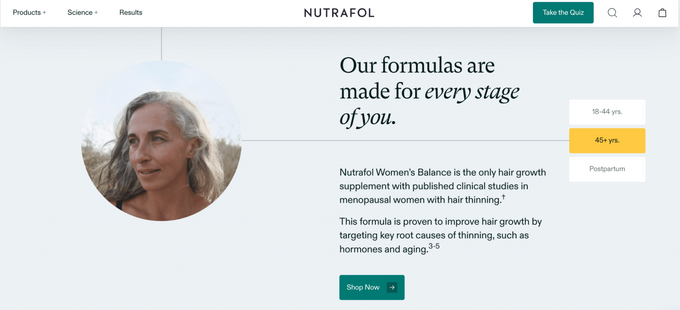
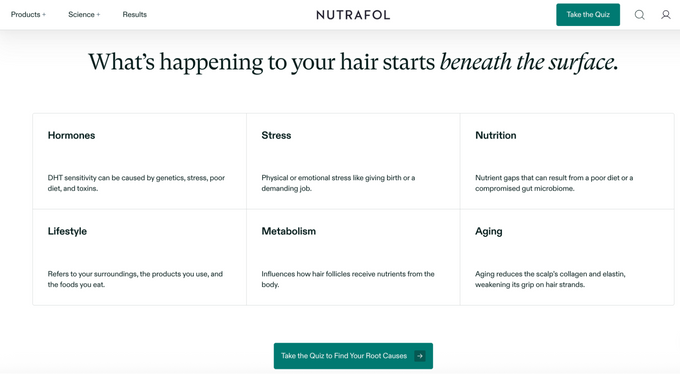
For example, Nutrafol doesn't just say "supplements for hair growth." Its messaging targets the root causes of thinning hair with a drug-free, clinically tested solution tailored to different life stages. It speaks to a specific problem, differentiates on approach, and makes a promise visitors can quickly judge for themselves.
2. Reduce friction in forms and checkout
Every field in a form is a potential reason to abandon it. Audit your forms and remove anything that isn't strictly necessary. Baymard's ongoing checkout research consistently identifies the following as the most common friction points leading to abandonment:
- Forced account creation: Requiring registration before purchase blocks a large share of first-time buyers.
- Excessive form fields: Asking for information that isn't needed at that stage increases drop-off.
- Unclear error messages: Vague validation errors frustrate users and increase abandonment.
- Hidden costs at checkout: Unexpected fees at the payment step are a leading cause of cart abandonment.
For e-commerce checkouts, offer guest checkout, minimize the number of steps, and make it clear what information is required at each stage.
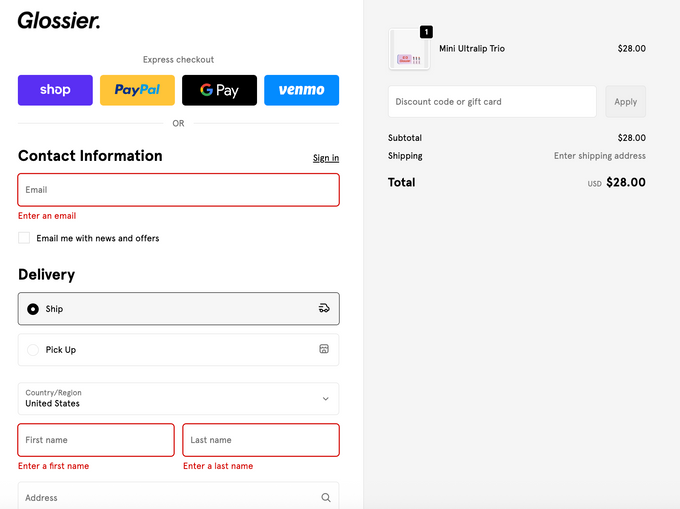
For example, Glossier’s checkout keeps everything on a single, focused page: it highlights express payment options, lets shoppers reuse their shipping address as the billing address with one click, and keeps the order summary visible so there are no surprises. This flow reduces typing, decisions, and confusion.
3. Strengthen your calls to action
CTAs should be specific, visible, and benefit-oriented. "Get started" is weaker than "Start your free trial." "Learn more" is weaker than "See how it works." The language should reflect what the visitor gets, not what you want them to do.
Placement matters too. A visitor who has just read a detailed product explanation is more likely to act on a CTA at that moment than one who hasn't read anything yet. Place CTAs where they're logically prompted by the content surrounding them.
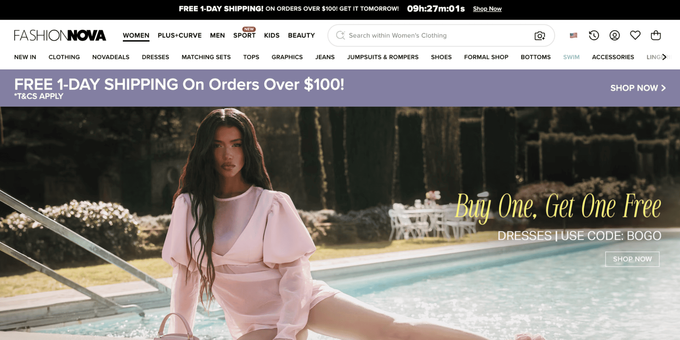
For example, Fashion Nova’s homepage stacks several clear calls to action: an urgency‑driven announcement bar (“Free 1‑day shipping on orders over $100”) with a “Shop Now” link, plus a hero that leads with a specific offer (“Buy One, Get One Free” on dresses). This combination makes the value obvious and tells visitors exactly what to do next.
4. Use social proof strategically
Social proof reduces the perceived risk of taking action. Position it near the moments where hesitation is highest: adjacent to forms, near pricing details, or where a visitor would typically pause and question their decision.
The most effective formats include:
- Customer testimonials: Specific outcomes from recognizable company types carry more weight than generic praise.
- Case studies: Detailed results for visitors evaluating whether the product is right for their situation.
- Star ratings and review counts: Quick trust signals that work well near CTAs and on product pages.
- Client logos: Particularly effective for B2B, where brand association signals credibility.
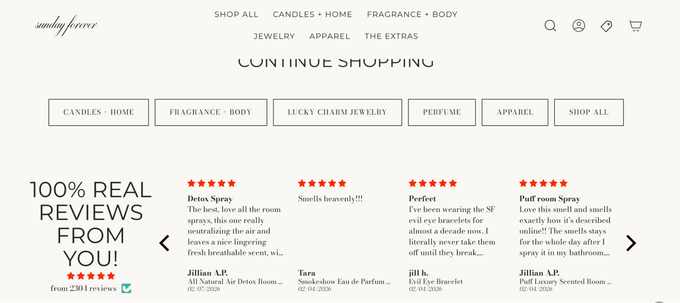
For example, Sunday Forever dedicates a full band on the page to social proof: a bold “100% real reviews from you” header, an aggregate star rating from thousands of reviews, and a carousel of specific, named customer quotes right below the product categories. Placing that wall of proof directly in the browsing flow reassures hesitant shoppers.
5. Optimize page load speed
Google's research has shown that as page load time increases, the probability of a visitor bouncing increases sharply. A page that loads in one second converts significantly better than one that takes five seconds.
Start with your Core Web Vitals scores in Google Search Console or PageSpeed Insights. Common quick wins include:
- Compressing images: Often the single largest contributor to slow load times.
- Minimizing render-blocking scripts: Deferred or async loading prevents scripts from blocking page render.
- Enabling browser caching: Returning visitors load pages faster when assets are cached locally.
- Using a CDN: Reduces latency for visitors who are geographically distant from your server.
Improvements here benefit both conversion rate and organic search performance.
6. Fix mobile UX issues
More than half of global web traffic now comes from mobile devices, yet mobile conversion rates typically lag desktop rates by a significant margin. This gap is almost always a UX problem.
Common culprits include:
- Buttons that are too small to tap accurately: Elements should meet Google's 48x48px minimum touch target guideline.
- Forms that require horizontal scrolling: Fields should be sized for portrait mobile viewports.
- Checkout flows not designed for touchscreens: Multi-step processes that work on desktop often create significant friction on mobile.
Test your site on real devices, not just emulators. Walk through your primary conversion flow as a first-time mobile visitor and identify anything that creates unnecessary effort.
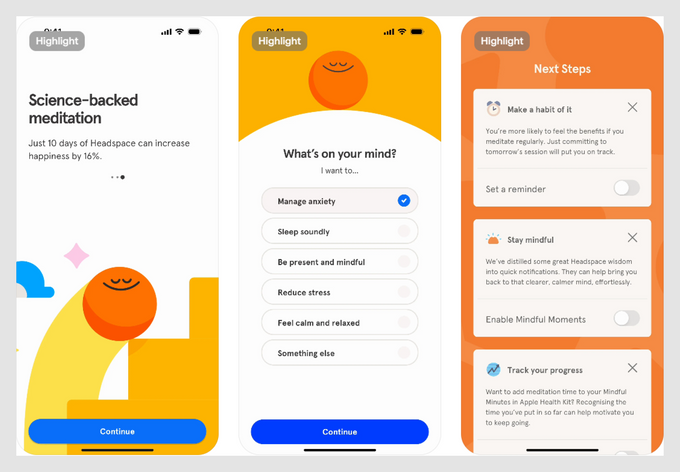
For example, Headspace’s mobile onboarding flow uses large tap targets, single‑column layouts, and plain‑language prompts like “What’s on your mind?” with simple choices such as “Manage anxiety” or “Sleep soundly.” Everything important sits within easy thumb reach and on screen at once, so users can move through the flow quickly.
7. Use behavioral data to prioritize CRO tests
Heatmaps, session recordings, and click maps reveal patterns that quantitative analytics miss. You might discover that visitors are clicking on a non-clickable element expecting it to do something, or that a key CTA is being ignored because it sits below the scroll depth most visitors reach.
These insights help you build sharper hypotheses and prioritize the changes most likely to move the needle.
8. Add simple personalization
Personalization doesn't have to mean sophisticated machine learning. Showing different content or offers to first-time visitors versus returning visitors, or adjusting messaging based on traffic source, can produce meaningful lifts with relatively modest technical investment.
According to McKinsey's research on personalization, companies that lead in personalization generate 40% more revenue from those activities than average players. The opportunity is significant, especially for businesses with enough traffic to segment meaningfully.
9. Run CRO as an ongoing testing program
Individual tests matter less than the organizational commitment to continuous learning. The businesses that consistently improve their conversion rates treat CRO as an ongoing program rather than a project with an end date. That means documenting every test, sharing learnings across teams, and always having a next hypothesis in the queue.
Erin Choice , CRO Specialist at CROforce
Conclusion
Website conversion rate optimization is one of the most cost-efficient growth levers available to any digital business. By focusing on understanding visitor behavior, systematically reducing friction, and testing changes with discipline, you can extract significantly more value from the traffic you already have.
The benchmarks in this guide give you a reference point, but your own baseline is the only number that truly matters. Even a modest lift in conversion rate, applied consistently, compounds into meaningful revenue over time.
» Book a demo with a CROforce expert to identify conversion opportunities on your website
FAQs
What is website conversion rate optimization?
CRO is the process of increasing the percentage of website visitors who complete a desired action, such as making a purchase, requesting a demo, or signing up. It uses data analysis, user research, and A/B testing to identify and remove barriers to conversion.
What is a good website conversion rate?
It depends on your goal and funnel stage. Rates in the 2% to 5% range are common across many industries, but these figures blend different goal types and should be treated as directional context only. Establish your own baseline, segment by goal and funnel stage, and focus on consistent improvement from there.
How do you calculate website conversion rate?
Divide the number of conversions by the total number of visitors, then multiply by 100. For example, 200 conversions from 10,000 visitors equals a 2% conversion rate.
How long does it take to see results from CRO?
It depends on your traffic volume. A high-traffic page may reach statistical significance in one to two weeks. Lower-traffic pages can take several weeks or months. Running tests for too short a period risks decisions based on noise rather than signal.
What's the difference between CRO and SEO?
SEO attracts more visitors by improving search visibility. CRO converts more of the visitors you already have. The two work best together: SEO brings traffic in; CRO ensures more of it results in business outcomes.
What tools are used for website CRO?
Common tools include analytics platforms like Google Analytics 4, behavioral tools like heatmaps and session recording software, A/B testing platforms, and on-site survey tools. Many businesses also work with managed CRO services that combine tooling with expert test management.
Is CRO only relevant to e-commerce?
No. CRO applies to any website with a conversion goal, including SaaS (trial sign-ups), B2B (lead generation), and media (newsletter subscriptions). The tactics differ by context, but the underlying process of measuring, hypothesizing, and testing is consistent.