
B2B conversion rate optimization: strategy, metrics, ROI (& more)
B2B CRO means optimizing for buying committees, not individuals, with lead quality and pipeline as the measures that matter. The highest-leverage strategies are addressing multiple stakeholder needs, reducing form friction, matching messaging to your ICP, and letting behavioral data drive your tests.






Updated March 25, 2026

Most B2B CRO guides recycle the same advice: shorten your forms, test your CTAs, improve page speed. That advice isn't wrong. It's just incomplete.
B2B is harder because you're not converting one person. You're converting a buying committee, and most of its members have already done their research before your team ever hears from them. The person who fills out your demo form is just one stakeholder in a decision that plays out in meetings and budget reviews you'll never see.
Getting more form fills isn't the goal. Getting more qualified leads that become pipeline is. This guide covers what B2B CRO actually involves, which metrics to track, and where to focus to move revenue, not just conversion rate.
What is B2B conversion rate optimization?
B2B conversion rate optimization is the process of improving your website and digital assets so that a higher percentage of business buyers take a meaningful action, whether that's requesting a demo, downloading a guide, or booking a meeting.
The formula is simple:
Conversion rate = (conversions / total visitors) × 100
If your pricing page gets 2,000 visitors per month and 60 request a demo, your conversion rate is 3%.
The complexity in B2B isn't the math. It's what the number actually means.
For example, a page that converts 8% of visitors looks great on paper. But if those leads rarely become sales-qualified, the high conversion rate is misleading. A page converting 3% of visitors into leads with a 40% SQL rate is doing more for the pipeline.
Core challenge of B2B CRO
Volume and quality pull in different directions, and optimizing for one without tracking the other can actually hurt revenue. The goal isn't more form submissions. It's more of the right form submissions, from buyers who match your ICP and have the intent and authority to move a deal forward.
How B2B CRO differs from B2C
Understanding the structural differences between B2B and B2C buying helps explain why B2B optimization requires a different approach.
- Multiple decision makers: Recent Gartner survey data indicate that B2B buying groups now typically range from five to 16 stakeholders across multiple functions. Each member arrives with their own priorities, objections, and success criteria. Your site has to address more than one point of view.
- Self-directed research: Gartner's 2025 Sales Survey found that around 61% of B2B buyers would prefer a rep-free buying experience. The bulk of their journey happens on your site, on review platforms, and in internal discussions your team never sees. This makes your web experience the most important sales tool you have.
- Longer cycles: B2B purchases involve higher budgets, greater organizational risk, and more internal scrutiny. Sales cycles often run for weeks or months. A visitor won't convert on their first session, which means micro-conversions (content downloads, newsletter signups, webinar registrations) matter as entry points to a longer nurture journey.
- Risk-weighted decisions: B2B buyers aren't spending their own money. They're accountable to their organization for the outcome. That raises the stakes on trust, credibility, and proof. A missing security certification or a vague ROI claim can end a deal before it starts.
- Intent-based traffic: B2B sites tend to get lower traffic volumes but higher-intent visitors. A 2% conversion rate on a high-intent B2B page can represent significantly more pipeline value than a 5% rate on low-intent traffic.
What counts as a conversion in B2B?
B2B conversions are typically divided into two categories: macro conversions and micro conversions.
Macro conversions
Macro conversions are the primary actions that signal purchase intent and create sales opportunities:
- Demo requests: The clearest signal of intent on most B2B sites.
- Free trial signups: Common in SaaS, where product-led growth is a conversion path.
- Contact form submissions: For services businesses or consultative sales models.
- Pricing page inquiries: Often the last touchpoint before a lead enters the sales funnel.
- Meeting bookings: Direct calendar integrations that skip the form-fill step entirely.
Micro conversions
Micro conversions support the macro conversion path and help move prospects through a longer buying cycle:
- Content downloads: Whitepapers, templates, and guides that demonstrate expertise.
- Webinar registrations: Higher-intent than a blog read, but not yet a sales signal.
- Newsletter signups: Keeping prospects in your orbit between active research phases.
- Case study views or downloads: Particularly useful for stakeholders who need proof before recommending a vendor internally.
- Pricing page visits: Not a conversion in themselves, but a strong behavioral signal.
Tracking both levels of conversion gives you a clearer picture of where prospects are in their journey and where friction is causing drop-off before they reach the macro conversion point.
Key B2B CRO metrics to track
These are the metrics that give you a meaningful signal in a B2B CRO program. Tracking them consistently and linking them to downstream pipeline data is what separates revenue-focused optimization from surface-level A/B testing.
- Conversion rate by page and channel: Track conversion rates at the page level (demo page, pricing page, feature pages) and by traffic source (organic, paid, email). This lets you pinpoint underperforming pages and understand which channels are sending your most qualified traffic.
- Lead-to-SQL rate: The percentage of inbound leads that qualify as sales-qualified leads. A low lead-to-SQL rate alongside a high conversion rate is a warning sign that your page is converting unqualified visitors, not your target buyers.
- Form completion rate: The percentage of visitors who start a form and actually submit it. Drop-offs in form completion often reveal friction caused by form length, field type, or placement.
- Form start rate: The percentage of page visitors who begin filling out a form at all. A low start rate suggests the CTA isn't compelling enough or isn't visible to enough visitors.
- Cost per lead (CPL) and cost per SQL: Both matter, but cost per SQL is the more useful B2B metric because it accounts for lead quality. Reducing CPL at the expense of SQL rate doesn't help the pipeline.
- Landing page bounce rate and time on page: High bounce rates combined with short time on page usually point to a messaging mismatch, where the ad or search result promised something the page didn't deliver.
- Pipeline contribution from organic and paid: The percentage of your total pipeline that can be traced back to specific pages or campaigns. This is the metric that connects your CRO work directly to revenue.
- Win rate by source: Tracking which acquisition channels produce leads that close at the highest rate helps you prioritize optimization effort on the pages that generate your best customers, not just your most leads.
Common Challenges of B2B CRO
The data on how B2B buyers actually behave has significant implications for CRO strategy. A few trends are worth understanding before deciding where to focus your optimization work.
Buyers don't wait for sales
Aggregated research on B2B buying behavior suggests that a significant share of buyers, often cited at over 40%, arrive with a preferred vendor already in mind before formal evaluation begins, and many have an internal shortlist by the time they first submit a form. By the time someone requests a demo, they've typically already formed a view. Your site either reinforced it or undermined it.
Buying groups often can't agree
Gartner's 2025 data found that 74% of B2B buyer teams experience unhealthy conflict during the decision process. Buying groups that do reach consensus are 2.5 times more likely to report a high-quality outcome. For CRO, this means your site needs to speak to multiple stakeholder concerns simultaneously, not just the person who clicked the link.
Benchmarks are directional, not targets
First Page Sage's 2026 data puts average organic conversion rates for B2B product and service landing pages in roughly the 2.7%–2.9% range, with richer content like ROI calculators and case studies often lifting those numbers further. Rates vary significantly by funnel stage, offer type, and ICP match, so use them as context for evaluating your own pages, not as universal targets.
Self-service is an expectation, not a nice-to-have
With 61% of buyers preferring to research and evaluate without involving a rep, your site has to do more of the selling. That means detailed product information, transparent pricing where possible, ROI calculators, and comparison content that helps buyers make the case internally.
7 B2B CRO strategies for 2026
1. Optimize for the buying committee, not just the lead
Most B2B landing pages are written for a single persona. But the person who fills out your demo form is often a practitioner or champion, not the final decision maker. The CFO reviewing the proposal, the IT manager assessing security risk, and the department head evaluating fit all have different concerns.
Your site needs to provide content that covers all of these perspectives, without overwhelming any one visitor. Practically, this means:
- Having dedicated pages or sections for different buyer roles (IT, Finance, Operations).
- Including security and compliance information clearly and accessibly.
- Providing ROI frameworks and business case templates that champions can use internally.
- Keeping your core message simple and consistent
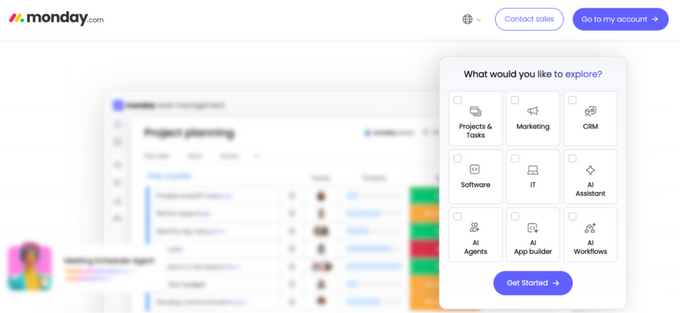
Monday.com does this on its homepage with a self-selection widget that lets each visitor choose their own use case rather than landing on a page trying to speak to everyone at once.
2. Reduce form friction
Form length is one of the most commonly tested variables in B2B CRO, and the relationship between field count and conversion rate is real but not always linear. Shorter forms don't always mean more qualified leads. The goal is the right form length for your sales model.
Some principles that hold across most B2B contexts:
- Progressive profiling: If you use a marketing automation platform, collect the most critical fields on the first form and capture additional data on subsequent interactions rather than front-loading a single long form.
- Remove fields you don't actually use: If your sales team doesn't use the "company size" field to qualify or route leads, it's friction with no benefit.
- Use inline validation: Catching field errors as users type significantly reduces form abandonment, rather than surfacing error messages at submission.
- Test single-column layouts: Multi-column forms tend to increase completion errors and cognitive load.
- Consider conversational forms: For high-intent pages like pricing or demo requests, a multi-step format can feel less daunting than a single long form.
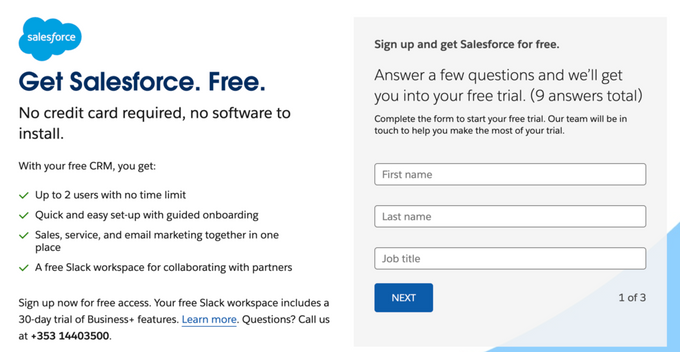
Salesforce's free trial signup is a good example. Rather than presenting all nine fields at once, they break the form into three steps, each with just two or three fields. The progress indicator ("1 of 3") sets clear expectations, and the commitment feels manageable at each step.
3. Build trust signals that matter to B2B buyers
Social proof in B2B works differently from B2C. A consumer might be persuaded by a 4.8-star rating and a volume of reviews. A business buyer is looking for specific, verifiable proof that your solution has worked for organizations similar to theirs.
Trust signals that carry weight in B2B:
- Industry-matched logos and case studies: Logos alone are table stakes. Case studies with specific outcomes tied to a recognizable company in the buyer's sector are far more persuasive.
- Security and compliance certifications: SOC 2, ISO 27001, GDPR compliance, and similar certifications need to be visible and linkable, not buried in a footer or a dedicated security page that requires three clicks to find.
- Review platform ratings: G2, Capterra, and TrustRadius scores, particularly when embedded close to your CTA, reduce the risk perception that stalls B2B purchase decisions.
- Named testimonials with context: "Jane Smith, VP of Operations at Acme Corp" is more credible than a generic quote with a first name and an industry label. Where buyers have consented to be named, use the full attribution.
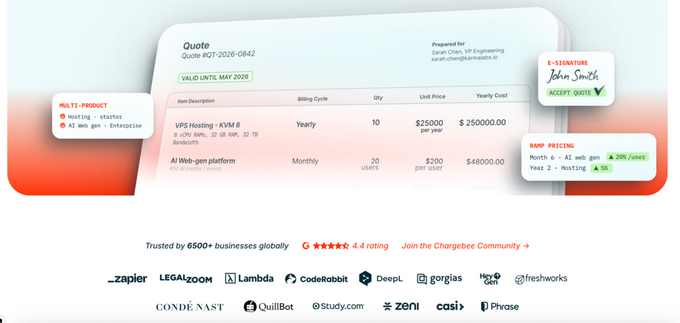
Chargebee's homepage layers all of these together effectively: a Gartner Magic Quadrant Leader badge for authority, a G2 rating with a "trusted by 6,500+ businesses" count for social proof, named video testimonials with full job titles (such as VP of Data and Platform Engineering at LegalZoom), and industry-filtered logos so each visitor sees relevant names.
4. Match page messaging to ICP segments
A landing page written for a generic "B2B buyer" is less effective than one written for a specific industry vertical, company size, or use case. When a visitor arrives at a page that directly addresses their context, conversion rates improve because the relevance gap disappears.
This doesn't necessarily require building dozens of separate pages. It can mean:
- Creating variant landing pages for your highest-value ICP segments, particularly for paid campaigns
- Using dynamic content to serve different headlines or testimonials based on the visitor's source or firmographic data
- Aligning ad copy and landing page copy so that the transition from click to page feels continuous rather than jarring
Message-to-market match is one of the highest-leverage CRO levers in B2B, and one of the most commonly underused.
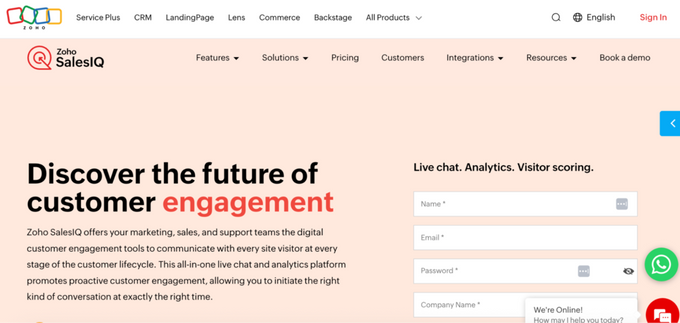
Zoho does this at the product level: service teams land on Zoho Desk, sales and marketing teams land on Zoho SalesIQ, each with its own messaging, use cases, and CTAs. No single page tries to speak to everyone. Each visitor gets a page built for their role.
5. Improve CTA clarity and placement
B2B CTAs fail for a few consistent reasons: they're too vague ("Learn more"), they're buried below the fold, or they don't match the visitor's readiness level. Not every page visitor is ready to request a demo. A CTA hierarchy that offers options at different commitment levels keeps lower-intent visitors engaged rather than pushing them off the page.
A tiered CTA approach might look like:
- Primary CTA: Demo request or free trial, above the fold, repeated at logical break points
- Secondary CTA: Case study download or ROI calculator, for visitors in research mode
- Tertiary CTA: Newsletter signup or resource library access, for early-stage visitors building a shortlist
CTA button copy also matters more than it's often given credit for. "Get a demo" outperforms "Submit" in most B2B contexts. "See it in action" often converts better on product-specific pages than "Request a demo." Testing even small copy changes on high-traffic CTAs is typically worth the effort.
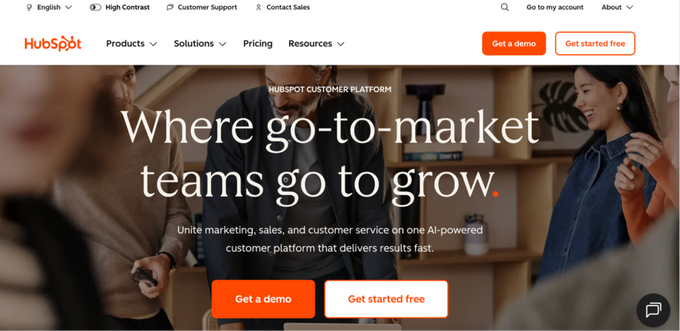
HubSpot's homepage puts this into practice with two CTAs above the fold: a solid "Get a demo" for high-intent visitors and an outlined "Get started free" for those not ready to talk to sales. Both options are repeated in the nav, so neither gets buried regardless of where a visitor's attention lands.
6. Prioritize page speed and core web vitals
Page speed is a conversion lever and an SEO factor, and the two interact. Slow pages lose visitors before they even see your value proposition. Google's Core Web Vitals guidelines recommend targeting specific performance thresholds to provide a reliably fast, stable experience that supports both rankings and on-page engagement.
For B2B sites specifically, aim for:
- Largest Contentful Paint (LCP): Target under 2.5 seconds. Slow hero image loading is a common culprit on B2B landing pages.
- Interaction to Next Paint (INP): Target under 200ms. Heavy JavaScript from third-party scripts (chat widgets, analytics tags) is the most common cause of poor INP scores on B2B sites.
- Cumulative Layout Shift (CLS): Target under 0.1. Layout instability from late-loading elements (particularly above-fold banners) erodes trust and increases bounce rates.
7. Use behavioral data to prioritize your tests
Without a data foundation, CRO becomes guesswork. Before running A/B tests, you need to understand where visitors are dropping off and why. Heatmaps, session recordings, and funnel analysis tools give you the behavioral data to form specific, testable hypotheses rather than testing random page elements.
A practical prioritization framework:
- Identify your highest-traffic, highest-intent pages (typically pricing, demo, and primary feature pages). These have the most conversion leverage.
- Map the drop-off points in your funnel using analytics. Where are visitors leaving without converting?
- Use heatmaps and session recordings to understand the behavior behind the data. Are visitors scrolling past the CTA? Abandoning the form at a specific field? Hovering on elements that aren't clickable?
- Formulate a clear hypothesis before each test: "Changing X from Y to Z will increase conversion rate because [observed behavioral reason]."
Testing without a hypothesis is how CRO programs generate a lot of data and very little insight.
Erin Choice , CRO Specialist at CROforce
» Want to see what a structured B2B CRO program looks like in practice? Book a demo with CROforce.
How to measure the ROI of B2B CRO
One reason CRO programs lose executive support is that their results tend to be reported in web metrics (conversion rate, form submissions) rather than business outcomes (pipeline, revenue). Translating CRO results into revenue impact is straightforward once you have the right data connected.
A basic B2B CRO ROI model:
- Baseline: Current monthly conversions × lead-to-SQL rate × SQL-to-opportunity rate × win rate × average contract value = monthly pipeline contribution
- Post-optimization: Apply the same formula with updated conversion numbers
- Lift: The difference between baseline and post-optimization pipeline contribution
- ROI: (Lift in pipeline contribution − cost of CRO program) / cost of CRO program × 100
For example, if your homepage generates 100 demo requests per month, 30% of which become SQLs, 40% of those become opportunities, and your win rate is 25% with an ACV of $24,000, your monthly pipeline contribution is $72,000. A CRO change that increases demo requests to 120 while maintaining lead quality adds $14,400 in monthly pipeline contribution.
This model depends on having clean CRM data and attribution that connects web conversions to closed deals. If that connection doesn't exist yet, building it is a prerequisite for running a credible CRO program.
Erin Choice , CRO Specialist at CROforce
Getting B2B CRO right takes more than a checklist
B2B conversion rate optimization works when it's connected to real buyer behavior, tied to pipeline outcomes, and grounded in a testing process that builds on what the data actually shows. The strategies above give you a framework. What makes them effective is applying them to your specific funnel, your specific ICP, and the specific friction points your buyers are actually experiencing.
» Still losing qualified visitors before they convert? Talk to a CROforce expert to find out where and why
FAQs
What's a good conversion rate for a B2B website?
Analyses of First Page Sage's 2026 B2B benchmarks suggest average organic conversion rates for B2B product and service pages tend to cluster around 2.7%–2.9%, with the broader low single digits being a reasonable directional range across most B2B contexts. Treat any benchmark as context for evaluating your own performance, not a universal target.
What's the difference between a macro conversion and a micro conversion in B2B?
A macro conversion is a high-intent action like a demo request or free trial signup. A micro conversion is a lower-commitment signal like a content download or webinar registration. Tracking both shows where prospects are in the buying journey and where they're dropping off before reaching your primary CTA.
What's the difference between B2B CRO and B2C CRO?
B2B purchases involve multiple decision makers, longer sales cycles, and buyers who've done significant research before contacting your team. Optimization has to account for lead quality, not just form volume, and has to address the concerns of an entire buying committee, not a single individual.
How do you measure the ROI of a B2B CRO program?
Connect web conversion data to CRM pipeline data. Multiply the lift in qualified conversions by average contract value and win rate, then subtract the cost of the program. This requires clean attribution linking web sessions to closed deals.
Which pages should you prioritize for B2B CRO?
Start with the pages closest to the pipeline: demo request pages, pricing pages, and primary product pages. These carry the highest-intent visitors, so even a small conversion rate improvement has a direct effect on SQLs and opportunities.