
Wingify alternatives: When you've outgrown self-serve testing
Not every Wingify alternative solves the same problem. This guide reviews seven options by use case so you can match the right solution to your data stack, internal bandwidth, and testing velocity.






Published October 6, 2026

VWO and AB Tasty united under the Wingify brand in 2026, but the merger didn't change the problems that come with scale.
Page flicker, slower load times, and running experiments across multiple teams get harder to manage as programs grow. And without the right internal expertise, even the best A/B testing software often goes underused.
Teams evaluating VWO or AB Tasty alternatives tend to fall into two camps: those who need more technical capability, and those who need more execution support. This guide covers both, with each alternative reviewed against the specific gap it fills.
Our top 7 Wingify alternatives in 2026 at a glance

CROforce is a fully managed A/B testing service combining expert strategy, execution, and analysis.
Fully managed testing program, no in-house CRO team required
Expert-led test strategy, design, development, and reporting
Transparent flat-rate pricing with no MTU-based tier surprises

Optimizely calculates test results directly against your data warehouse, with CDN-level edge delivery and enterprise-grade governance.
Warehouse-native analytics against Snowflake, BigQuery, Databricks, or Redshift
CDN-level edge testing eliminates client-side flicker on high-traffic pages
Mutual exclusion groups for unlimited concurrent experiments

Adobe Target uses Adobe Analytics as its native reporting source, eliminating the integration layer Wingify requires on the Adobe stack.
Native A4T integration keeps test results and web analytics in one system
Auto-Allocate shifts traffic toward the winning variant mid-test
On-device decisioning runs tests at near-zero latency
Show more
7 best Wingify alternatives in {year}
1

CROforce
Fully managed service
Every aspect of the testing program is handled by CROforce's team, from strategy to development and analysis
Higher test impact
CROforce's experts identify the highest-leverage pages and elements on your site, so every test is built around the biggest possible uplift
Higher test velocity
CROforce removes the resourcing bottleneck, enabling teams to ship significantly more tests than a self-serve tool allows
Why we like it
Wingify is self-serve, which means your team carries the full weight of research, design, development, QA, and analysis. CROforce replaces that model entirely, pairing its testing platform with a dedicated team of specialists who handle every stage of the process.
For businesses with high traffic, multiple sites, or complex funnels, it's a more practical path to a high-velocity testing program than building an in-house CRO team from scratch.
Features
- Managed plans include a CRO audit, custom roadmap, and dedicated design and developer hours
- Run price, feature, and shipping tests alongside standard A/B and multivariate tests
- Run unlimited concurrent tests across high-traffic pages without flicker or slowdowns
- Test single-page applications (SPAs) without requiring page reloads
- Software-only plan available for teams that want to self-serve
Pricing
Transparent flat-rate pricing. The software-only plan starts at $234/month (billed annually). Managed service plans start at $1,710/month (Build), $2,923/month (Scale), and $4,137/month (Premium), all billed annually. A 14-day trial and 30-day money-back guarantee are available.
Pros and cons
Full-service model removes the internal resource and expertise bottleneck
Faster testing velocity than in-house teams running a self-serve tool
Transparent flat-rate pricing with no MTU-based tier surprises
No built-in session recordings
No native mobile app testing
2


Optimizely
Warehouse-native analytics
Calculates test results directly against your data warehouse as a single source of truth
CDN-level edge testing
Runs experiments at the CDN layer, eliminating client-side flicker on high-traffic pages
Mark AI
Optimizely's built-in AI engine generates test ideas, builds variations, and automatically interprets experiment results to surface the actions that matter
Why we like it
Wingify syncs data to your warehouse once per day, which means test results and warehouse analytics are always operating on different timelines. Optimizely calculates results directly against your warehouse data in real time, eliminating that lag.
It's built for enterprises with at least 250,000 monthly visitors, a dedicated experimentation team, and a data warehouse already in place. The platform has expanded significantly since its rebrand as an AI platform for marketing, with agentic experimentation capabilities now built into the core.
Features
- Feature Experimentation product gives engineers server-side SDKs and feature flags
- Warehouse-native analytics calculated against Snowflake, BigQuery, Databricks, or Amazon Redshift
- Edge Delivery executes web experiments at the CDN level with no client-side flicker
- Mark AI generates test ideas, interprets experiment results, and surfaces recommended actions
Pricing
Custom enterprise contracts only. Web Experimentation costs approximately $36,000 to $40,000 per year, priced on monthly tracked users (MTUs). Personalization and warehouse-native analytics are sold as separate modules.
Pros and cons
Sells web A/B testing, server-side feature testing, and warehouse-native analytics in one platform
Mutual exclusion groups allow unlimited concurrent experiments without traffic overlap
Two-time Gartner Leader in Personalization Engines as of 2026
Exceeding traffic allocation can trigger tier upgrades raising costs by 40 to 60%
Implementation and training often add 35 to 50% to year-one license costs
3
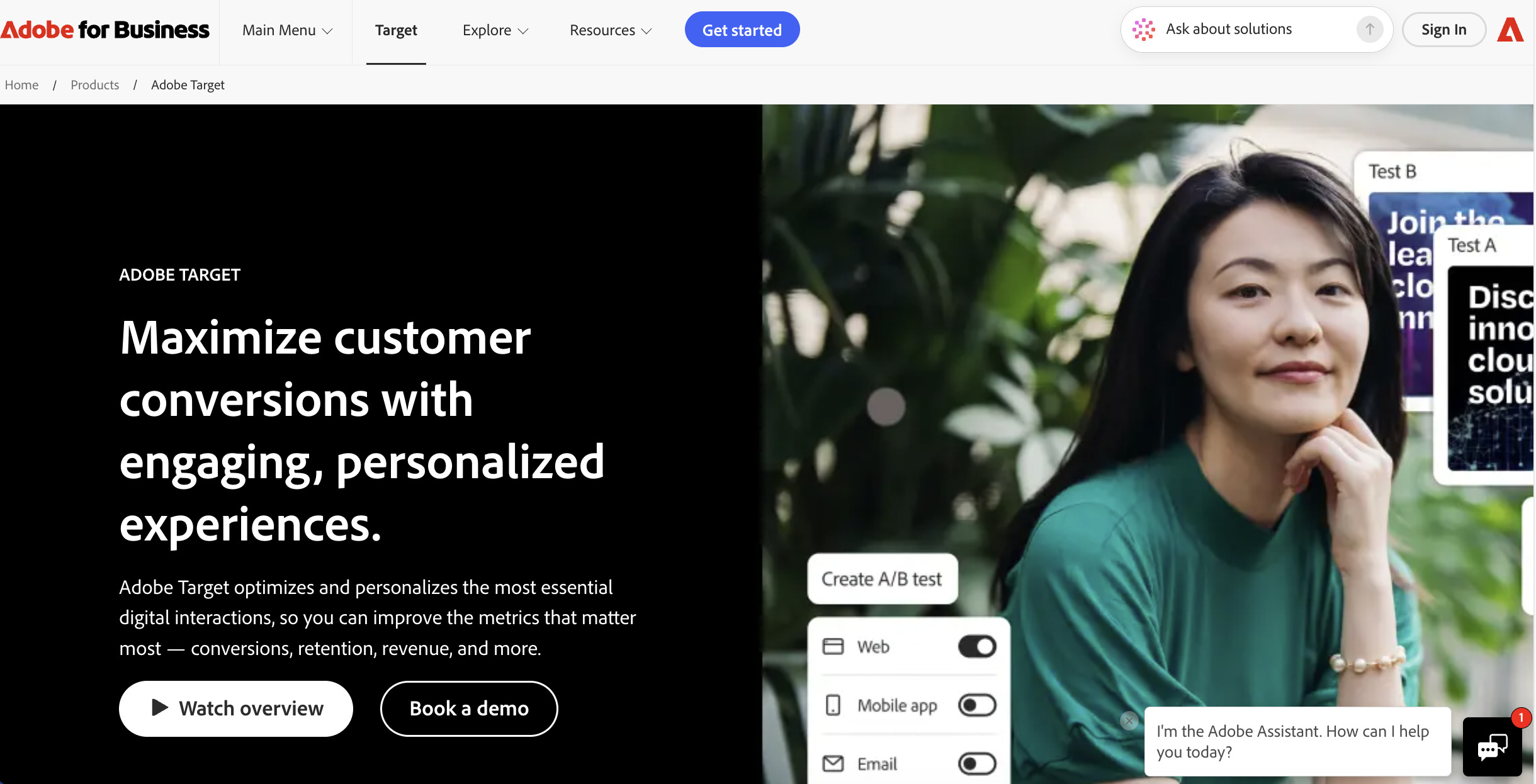
Adobe Target
Analytics for Target (A4T)
Uses Adobe Analytics as the native reporting source, so test results and web analytics come from the same data set
Auto-Allocate
Uses a multi-armed bandit algorithm to shift traffic toward the winning variation while the test is still running
On-device decisioning
Runs A/B and Experience Targeting at near-zero latency using locally cached rules, without a server call
Why we like it
Wingify is a separate vendor from Adobe, so companies on the Adobe stack have to connect it to Adobe Analytics through an integration, creating potential data discrepancies between test results and web analytics.
Adobe Target eliminates that by using Adobe Analytics as its native reporting source through A4T. It's purpose-built for enterprises already running Adobe Analytics and Adobe Experience Cloud across multiple websites and apps.
Features
- Analytics for Target (A4T) uses Adobe Analytics as the native reporting source for tests
- Auto-Allocate shifts traffic toward the winning variation mid-test using a multi-armed bandit algorithm
- Full-factorial multivariate testing identifies which specific page element drives the highest lift
- On-device decisioning runs tests at near-zero latency using locally cached rules
Pricing
Custom enterprise contracts based on server calls or impressions and the number of properties.
Pros and cons
Native A4T integration eliminates data discrepancies between test results and web analytics
Auto-Allocate reduces wasted traffic on underperforming variations mid-test
On-device decisioning runs experiments at near-zero latency without a server call
Auto-Target and Automated Personalization require the Premium license upgrade
Automated Personalization reports only on Target data, not Adobe Analytics data
4
Webtrends Optimize
All-inclusive licensing
Every feature is included in every plan, with no module-based add-ons or separate billing
Managed service option
An in-house team handles experiment ideation, development, design, and QA on the same license
Non-parametric statistics
Calculates significance for non-binomial metrics like order value using Wilcoxon and Kruskal-Wallis methods
Why we like it
Wingify splits testing, behavioral analytics, personalization, and feature experimentation across separately billed products. Webtrends Optimize bundles everything into a single license and adds an optional managed service, making it a strong fit for mid-market and enterprise teams without in-house optimization expertise.
It's also one of the few alternatives with a free tier, which makes it accessible to lower-traffic sites that want enterprise-grade features without a minimum contract.
Features
- Run client-side and server-side tests from the same Advanced Editor interface
- Fractional factorial multivariate testing reduces combinations and shortens test duration
- Calculate significance for revenue metrics using Wilcoxon and Kruskal-Wallis non-parametric methods
- Access a fully managed or hybrid service on the same license without switching platforms
Pricing
Traffic-based SaaS pricing with all features included, starting at £179/month. A free tier is available for low-traffic sites. Managed service pricing is available on request.
Pros and cons
Every feature included on every plan; no module-based add-ons like Wingify
Managed service available on the same license without switching platforms
Free tier available for low-traffic sites with no minimum contract
Managed service pricing is not published; requires a custom quote
Client-side tests can cause flicker unless the anti-flicker snippet is deployed correctly
5

Monetate
Network-layer delivery
Applies test variations before pages reach the browser via a reverse proxy, with no JavaScript tag and no flicker
Tagless testing
Unaffected by Safari ITP and Firefox ETP, which degrade cookie-based testing accuracy on client-side platforms
High-volume concurrency
Runs tens to hundreds of campaigns simultaneously without added latency, built for high-traffic environments
Why we like it
Wingify relies on a JavaScript tag, which causes either flicker on asynchronous loading or added latency on synchronous loading. Monetate Forte modifies pages in the network layer before they reach the browser, avoiding both.
It's built for medium and large enterprises in e-commerce, financial services, and travel that run extensive testing programs and have an IT team that can manage DNS changes.
Features
- Reverse proxy applies test variations before pages reach the browser with no JavaScript tag
- Tagless delivery unaffected by Safari ITP and Firefox ETP
- Run tens to hundreds of concurrent campaigns simultaneously without added latency
- Test APIs and mobile apps without embedding SDKs
Pricing
Custom enterprise contracts based on traffic volume or number of users.
Pros and cons
Network-layer delivery eliminates both flicker and latency trade-offs in one architecture
Tagless approach avoids ITP and ETP degradation that affects Wingify's client-side tag
Tests APIs and mobile apps without embedding SDKs
Setup requires DNS changes and IT involvement
Advanced test builds often require engineering support
6

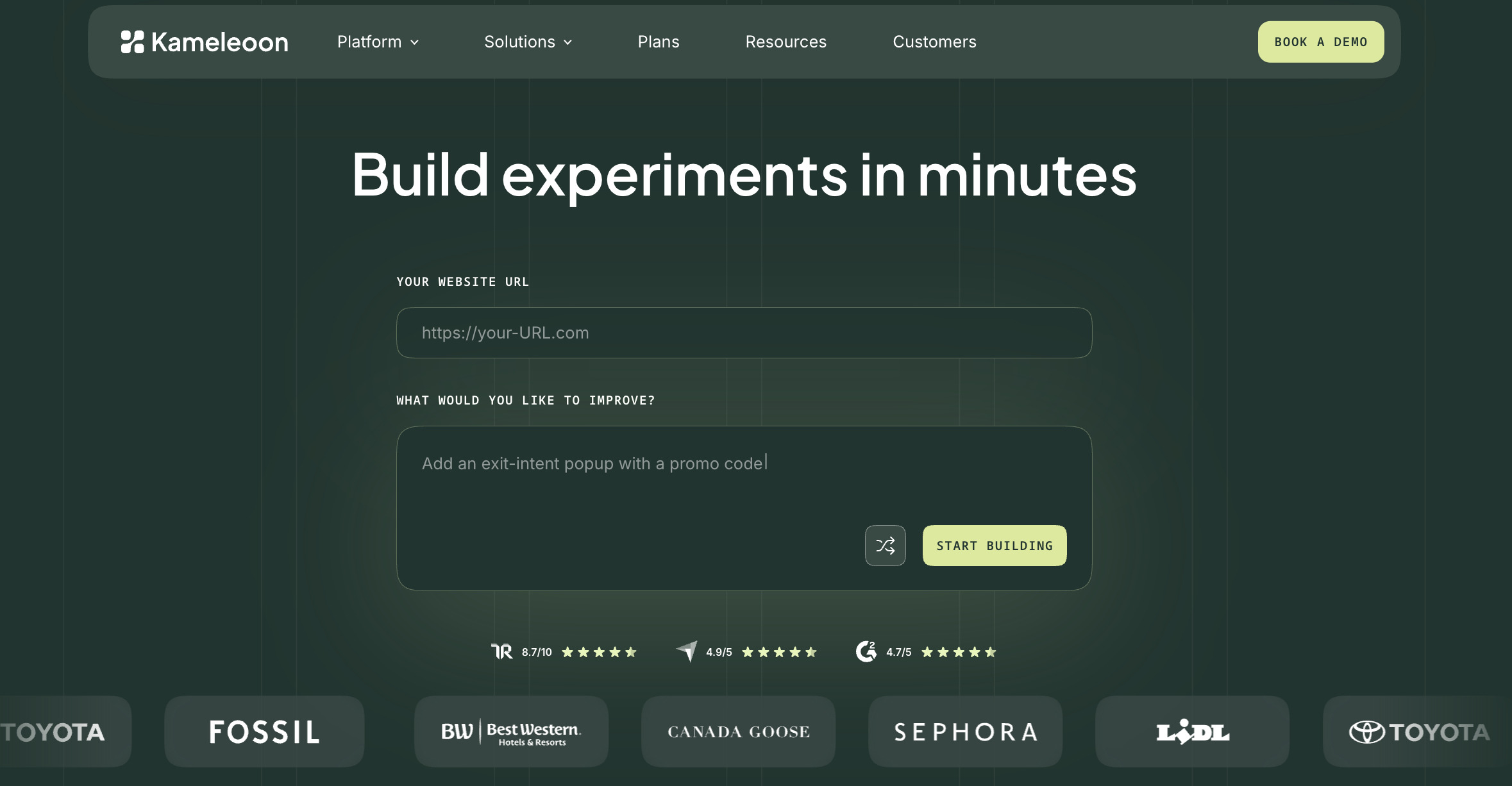
Kameleoon
Prompt-Based Experimentation
Builds a live A/B test from a plain-language chat prompt, without a visual editor or developer involvement
AI-powered targeting
Automatically scores visitors by conversion intent and serves the most relevant variant in real time, without manual audience rules
Warehouse-native integration
Imports audiences and metrics from Snowflake, BigQuery, Redshift, and Databricks for experiment targeting and analysis
Why we like it
Wingify sells web testing and server-side testing as separate products. Kameleoon combines both in a single platform, using web data for targeting and analytics in server-side tests without a separate developer workflow.
Its Prompt-Based Experimentation lets teams build and launch tests from a plain-language chat prompt, making it a practical fit for mid-market and enterprise companies in healthcare, banking, and insurance that need compliance built in rather than managed separately.
Features
- Build live A/B tests from plain-language chat prompts using Prompt-Based Experimentation
- Run hybrid experiments combining web targeting with server-side test execution
- AI-powered targeting automatically scores visitors by conversion intent and serves the most relevant variant
- Import audiences and metrics from Snowflake, BigQuery, Redshift, and Databricks for warehouse-native analysis
Pricing
Published Starter plan at $495/month for up to 10 experiments and 50,000 tested visitors. A 30-day free trial is available with no credit card required. Enterprise contracts are custom, based on monthly unique visitors (MUVs).
Pros and cons
Single platform for web experimentation, feature experimentation, and personalization
Prompt-Based Experimentation builds live tests without a visual editor or developer involvement
AI-powered targeting automatically routes visitors to the most relevant variant without manual audience rules
Hybrid experiments, server-side testing, CUPED, and warehouse-native integration are all Enterprise-only features
Advanced server-side features and complex targeting have a steep learning curve and often need developer support
7

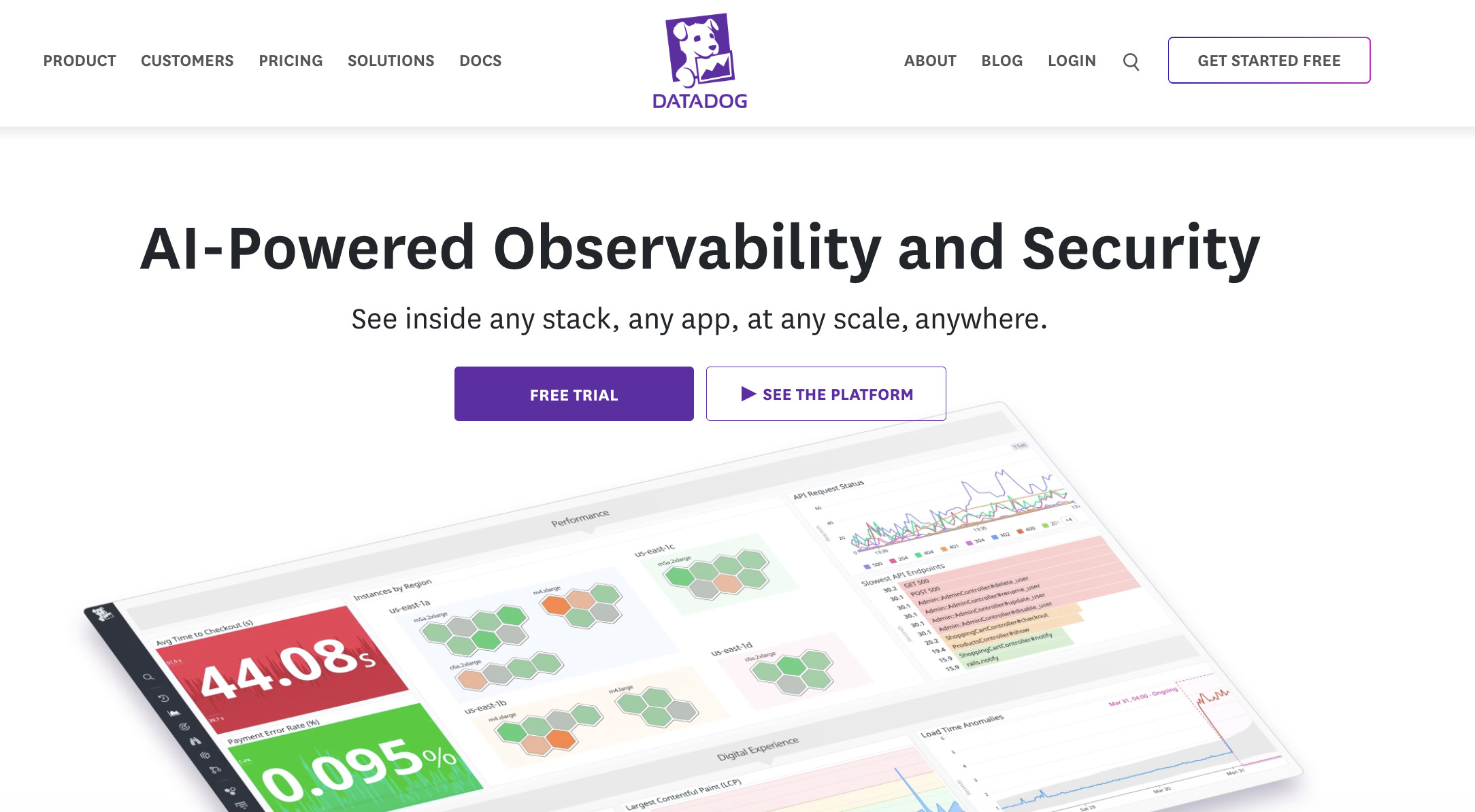
Datadog Experiments
Warehouse-native metrics
Measures business metrics directly in your data warehouse alongside your own feature flagging system
Observability integration
Combines experiment results with Datadog's application monitoring to catch bugs and automate canary testing at launch
Advanced statistical engine
Supports sequential, fixed-sample, and Bayesian methods with CUPED++ variance reduction and real-time diagnostics
Why we like it
Wingify is not an observability platform, so its experiment results sit apart from the tools engineers use to track errors and application performance. Datadog Experiments, part of Datadog since the 2025 acquisition of Eppo, solves this by combining warehouse business metrics with product analytics and application observability in one environment.
It's purpose-built for engineering teams already using Datadog who want to measure experiments against business metrics like revenue, retention, and LTV.
Features
- Measure business metrics directly in your data warehouse using warehouse-native mode
- Detect latency, error, and Core Web Vitals regressions tied to specific variants via RUM integration
- Apply CUPED++ variance reduction and sequential testing to reach results faster
- Flag sample ratio mismatch and instrumentation gaps in real time
Pricing
Transparent per-experiment pricing at $450 per launched experiment per month (billed annually), or $575 on-demand. Includes unlimited seats and 1M monthly flag configuration requests per experiment. An experiment becomes billable only after it reaches 500 subjects and 3 days of data.
Pros and cons
Combines experiment results with Datadog observability data in one environment
Warehouse-native metrics keep your data warehouse as the source of truth
Transparent per-experiment pricing with no seat-based costs
Costs scale with testing velocity; 10 experiments per month equals $4,500/month on annual billing
Measuring behavioral and performance impact requires separately purchased Datadog RUM or Product Analytics
How to choose the right Wingify alternative
The right alternative depends on your internal resources, your data setup, and how fast you actually need to test.
Match the tool to your data setup
If your data warehouse is already central to how your team measures performance, warehouse-native platforms like Optimizely or Datadog Experiments are a natural fit.
If regulatory compliance is non-negotiable, Kameleoon is purpose-built for those industries. If page speed is the constraint on high-traffic pages, Monetate's network-layer architecture solves it at the infrastructure level.
Know what you're actually testing for
Switching platforms won't fix a testing program that lacks a clear process. Before evaluating tools, it's worth checking whether your team has a structured approach to deciding what to test, how to run it, and how to read the results.
Getting that foundation right matters more than which platform you land on, especially if you're moving toward server-side A/B testing for the first time. A solid A/B testing framework will also help you get more out of whichever tool you choose.
Don't buy complexity you can't resource
One of the most common A/B testing mistakes teams make when switching tools is buying a more powerful platform without the team to run it. Before committing to another contract, look at how many tests your team shipped last quarter.
If the bottleneck is the people needed to plan, build, and analyze experiments, a managed A/B testing service like CROforce removes that constraint faster than a platform upgrade.
Key questions to consider when choosing an A/B testing platform
Switching tools takes time, budget, and internal alignment. Before you commit, these are the questions worth answering first:
- How many tests did your team ship in the last quarter? If the number is low, a more powerful platform is unlikely to change that.
- Who will actually build and analyze the tests? If the answer isn't clear, a self-serve platform will face the same bottlenecks as Wingify did.
- Are you testing the right things? Tools don't determine what to test. If your current results aren't moving, the issue may be test quality rather than the platform.
- Do you have enough traffic to reach statistical significance? Server-side tools and enterprise platforms don't speed up a test on a low-traffic page.
- Are your tests focused on the right parts of the funnel? A conversion funnel analysis before switching tools is often more valuable than the switch itself.
» Not sure what to test? Our A/B testing for UX guide covers how to identify the highest-impact areas on your site.
Stop switching tools, start shipping tests
The best Wingify alternative is the one that fits where your team actually is today, not where you plan to be. A warehouse-native enterprise platform is wasted on a team running two tests a month.
A self-serve tool becomes the ceiling the moment the real constraint is people, not software. Start with an honest look at your current testing velocity, and work backwards from there.
» Still managing tests in-house? Talk to a CROforce expert about a fully managed alternative