
How to use A/B testing to improve UX
UX A/B testing helps you compare different versions of website elements such as navigation, page layouts, CTAs, forms and pricing to see which experience performs better with real users. By testing UX changes instead of relying on assumptions, teams can identify what improves engagement and conversions and make more informed design decisions.






Published August 20, 2026

A website can look better, feel cleaner, and be easy to navigate and still underperform. That’s why A/B testing UX is so valuable. Instead of relying on opinions or assumptions, businesses can test different user experiences with real visitors and see what actually improves engagement and conversions. From navigation and page structure to pricing, CTAs and forms, A/B testing helps teams identify what works, what doesn’t, and where the biggest UX opportunities are.
In this blog, we’ll explore what UX A/B testing is, why consistent experimentation matters and when to choose A/B testing over other UX research methods.
Key takeaways
- UX A/B testing compares two or more versions of a website experience with real users to determine which version performs better.
- Consistent experimentation drives higher conversion rates, clear audience understanding, and lower business risk.
- Qualitative research methods uncover user problems, while quantitative A/B testing validates solutions at scale.
- Successful testing requires sufficient traffic, a clear minimum detectable effect, and reliable tracking analytics.
- Removing friction and simplifying design elements can generate massive revenue growth from existing traffic.
What is UX A/B testing?
UX A/B testing is a method of comparing different versions of a website’s user experience to see which one helps users complete key actions more effectively. Rather than testing marketing messages or offers, UX A/B testing focuses on changes to how users navigate, understand, and interact with a website.
The process starts with a UX hypothesis: “We think changing X will make it easier for users to do Y.” For example, you might hypothesize that simplifying a navigation menu will help users find products faster, or that making a CTA more prominent will increase form submissions.
You then create two versions of the experience: Version A, the existing UX, and Version B, which includes the proposed change. Real users are randomly split between the two, and their behavior is measured against predefined UX and business metrics. This shows whether the change actually improves the experience, and produces the intended outcome.
Benefits of consistent UX A/B testing
UX A/B testing can improve more than just a conversion rate. When testing becomes a consistent part of the optimization process, it can help businesses understand users, make better decisions, and reduce the risk of rolling out changes that don't work.
Higher conversion rates and revenue
The most obvious benefit of conversion rate optimization is the opportunity to improve measurable business outcomes. Testing can identify UX changes that increase sign-ups, purchases, leads, checkout completion, and revenue per visitor. By continuously testing and building on previous results, businesses can drive meaningful improvements over time.
Identify where users experience friction
UX A/B testing can help uncover points in the experience that make tasks unnecessarily difficult. This might include confusing navigation, too many form fields, unclear labels, poor information hierarchy, or unnecessary steps in a user flow.
For example, if users are struggling to find a particular product category, a team could test a simplified navigation structure to see whether it helps users find what they need more easily.
Make targeted improvements without a full redesign
UX A/B testing allows businesses to improve an existing experience without committing to a complete redesign. Teams can isolate specific elements and test changes incrementally, while keeping the parts of the experience that already work.
This could mean testing a shorter form, a different page layout, or a clearer navigation structure rather than rebuilding the entire website.
Improve navigation and discoverability
Users should be able to move through a website without having to work out where information or features are hidden. UX A/B testing provides a way to test different navigation structures, menus, filters, and search experiences to see which makes content easier to discover.
This is particularly useful for websites with large product catalogs or complex information architectures, where small navigation changes can significantly affect how users move through the site.
Build a growing library of knowledge
Over time, individual UX tests can reveal patterns in how users navigate, interpret information, and interact with different interface elements. These findings can inform future experiments and help teams develop a more evidence-based understanding of their audience.
The result is a continuous UX improvement process: identify a potential problem, test a change, learn from the result, and use that insight to improve the next experience.
» See how CROforce’s A/B testing software turns UX insights into confident business decisions
When should you choose UX A/B testing?
UX A/B testing is one of several methods teams can use to understand and improve user experience. The key difference is that each method answers a different type of question.
Some methods help you discover UX problems, such as why users are struggling or what they expect from an experience. Others help you measure behavior or evaluate an existing interface. UX A/B testing is most useful when you already have a specific idea for improving the experience, and want to determine whether that change performs better with real users.
What you want to investigate | Best method | Why it helps |
|---|---|---|
Understand why users are struggling to complete a task | Usability testing | Allows you to observe users interacting with the experience and identify where they become confused, frustrated or stuck |
Understand users' needs, expectations or motivations | User interviews | Helps uncover what users want to achieve and how they think about a product or experience |
Users' needs and expectations | User interviews | They help uncover users’ motivations, needs, expectations and attitudes towards an experience |
Identify potential usability issues in an existing interface | Heuristic evaluation | Allows UX experts to review an experience against established usability principles and identify potential problems |
Compare two different UX approaches | A/B testing | Shows which version leads to better outcomes based on real user behavior. |
Validate whether a specific UX change improves the experience | A/B testing | Tests whether a specific UX change, such as simplifying a form or navigation, improves user behavior |
Take note: If you still don't know what the problem is or why users are struggling, A/B testing may be too early. Interviews, usability testing or other qualitative research can help uncover the problem first. Qualitative research and quantitative experimentation work particularly well together: research can help generate the hypothesis, while A/B testing can help validate its impact at scale.
» See the most common A/B testing mistakes
What do you need before running a UX A/B test?
- A realistic minimum detectable effect (MDE): Decide how much improvement would actually matter before starting. Detecting a tiny 1% relative change requires considerably more data than detecting a 20% change.
- Reliable analytics and telemetry: You need to know who saw each variation and what they did afterwards. That means tracking the relevant events, conversions, and supporting behaviors accurately across both versions.
- A clearly defined control and variant: Version A needs to be a stable baseline, while Version B should contain the proposed change. Keeping the test focused makes it easier to understand what caused a difference.
- Random assignment: Users need to be assigned to versions in a way that allows a fair comparison. If one version receives a systematically different type of visitor, the result can be misleading. Experimentation platforms typically use random visitor bucketing for this purpose.
- A defined statistical approach: Before launching, decide how you will evaluate the result. A commonly used benchmark is 95% statistical significance, although the appropriate threshold depends on the test and the level of risk the business is willing to accept.
- A stable website experience: The experience being tested needs to work properly. Broken forms, tracking errors, technical problems or major changes happening during the experiment can contaminate the results. A/B testing is most useful when the underlying experience and measurement setup are reliable.
» Explore the CROforce platform to see how it supports your full testing program
Example of UX A/B testing
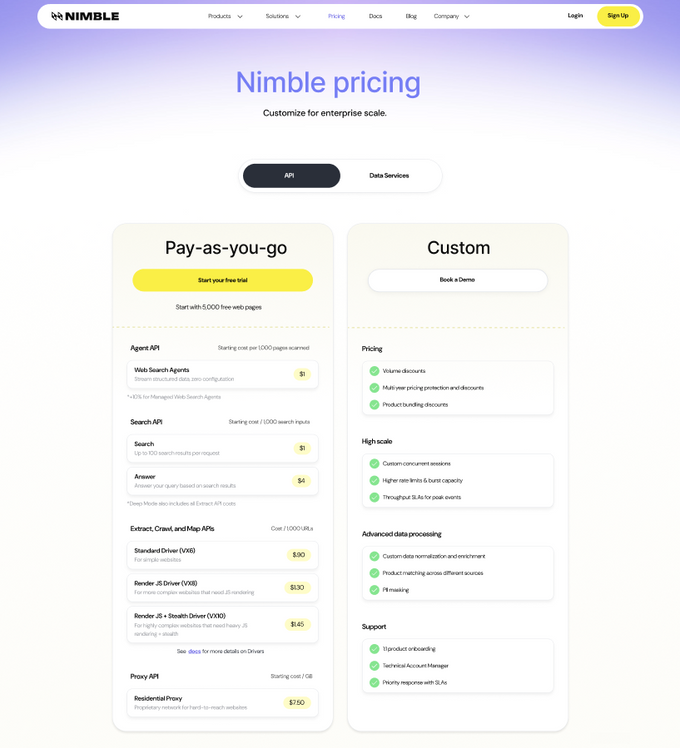
Nimble's pricing page had a clear UX problem: it was difficult for visitors to understand and navigate. With multiple options and information that wasn't easy to digest, the page was creating unnecessary friction at an important point in the customer journey.
CROforce tested whether a simplified pricing page would help visitors understand their options, compare plans, and take the next step.
The evaluation compared Nimble’s original layout against the redesigned version shown below.
Control:
Variant:
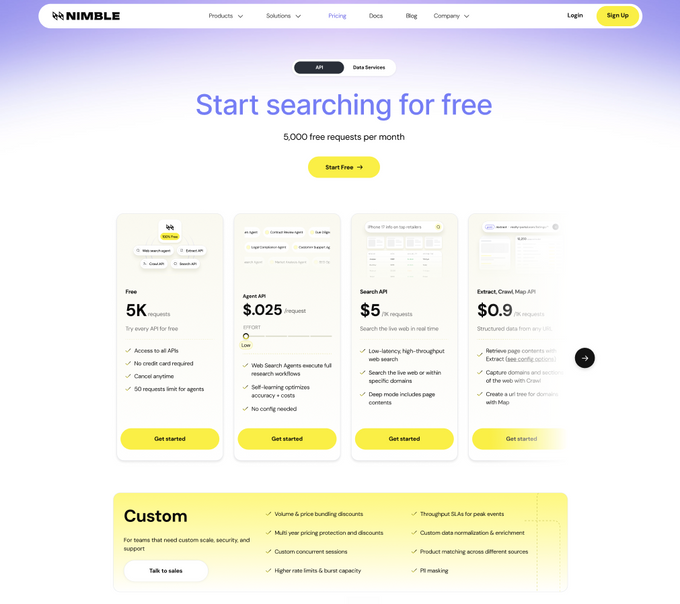
Goal: Make pricing easier to understand and reduce friction
The hypothesis: If users can understand and compare pricing more easily, they will be more likely to convert.
The results:
- 70.7% conversion rate uplift
- 68.6% increase in revenue per visitor
What this tells us
The biggest takeaway isn't simply the 70.7% uplift. It's what caused it. Nimble didn't need to attract more visitors. The opportunity was already within the existing traffic. By making the pricing experience clearer, easier to compare, and easier to navigate, more visitors were able to move forward.
» Want a tool that keeps your price tests clean? Check out the best A/B testing tools
Turn UX insights into measurable growth
UX A/B testing gives businesses a way to replace assumptions with evidence. Instead of deciding that a new layout, CTA or navigation structure should work better, teams can test the change with real users and measure what actually happens.
But running impactful experiments takes more than a testing tool. Teams need the right hypotheses, data, UX expertise, development resources, and time to keep the testing cycle moving. This is where CROforce can help. Its platform allows teams to test different website elements without relying on developers for every experiment, while CROforce's experts can support the full process, from identifying opportunities and designing experiments to launching tests, and analyzing the results.
» Book a demo with CROforce to see how managed experimentation can grow your business
FAQs
What is UX A/B testing?
UX A/B testing compares two versions of a website experience to see which performs better with real users. The versions can differ in areas such as page layout, navigation, CTAs, forms, pricing or content. The results are measured against predefined user and business metrics.
How is UX A/B testing different from following UX best practices?
Best practices provide useful starting points, but they do not guarantee that a change will work for a particular audience. A/B testing allows businesses to test those ideas against their own users and make decisions based on actual behavioral data.
What website elements can you A/B test?
Almost any measurable website element can be tested, including headlines, CTAs, hero sections, images, forms, navigation, pricing structures, trust signals and complete page layouts.
The most valuable tests are usually focused on areas where there is a clear user problem or significant business opportunity.
How much traffic do you need for a UX A/B test?
There is no single traffic threshold that works for every test. The required sample depends on factors such as your current conversion rate, the improvement you want to detect and the statistical confidence required.
Businesses with lower traffic may need to focus on larger, higher-impact changes or use qualitative research alongside experimentation.
How long should a UX A/B test run?
A test should run until it has collected enough data to make a reliable decision based on the planned sample size and testing approach. Avoid stopping simply because one variation looks like it is winning early.
The right duration depends on traffic volume, conversion rates and the size of the expected effect.