
A/B testing for landing pages: How to test the right page, the right way
Every landing page has room to convert better, and A/B testing is the easiest and most cost-effective way to create an uplift. Here's how to choose which landing pages and elements to test, run the test properly, and confirm the winner actually converts better.






Published July 31, 2026

Most landing pages have a conversion problem somewhere. When teams can't find it, the usual response is to keep tweaking the page or to send more traffic to it and hope that more visitors lead to more conversions. A/B testing enables you to find and fix the issue faster, but only when you know what to test and how to interpret the results. In this article, we'll explain how to do both so you can maximize conversion rates and ad spend.
Key takeaways
- A change might look good on paper but still end up lowering conversion rate, and A/B testing is the only way to know beforehand.
- Choose which pages and elements to test based on traffic, conversions, and revenue, not a hunch.
- A trustworthy result depends on hitting a real traffic threshold and changing only one thing at a time.
- The real measure of a winning variant is revenue per visitor and lead quality, not just a higher conversion count.
What is landing page A/B testing?
Landing page A/B testing means showing two versions of the same page, a control and a variant with one thing changed, to different groups of visitors, then comparing how each one performs. It's one part of a broader landing page optimization effort.
What a test could look like on different pages
- A SaaS signup page: Tests whether a short headline focused on one benefit outperforms a longer, feature-heavy one.
- An e-commerce landing page: Tests whether a lifestyle hero image outperforms a plain product shot.
- A lead-gen page for a service business: Tests whether a form asking only for an email converts better than one that also asks for a phone number and company size.
Why you should always test a change instead of just making it
Even a small change, like swapping one image, can affect landing page conversions. Testing tells you for certain whether a change actually helps before you commit to it, rather than finding out only after it's already live and affecting your bottom line.
If you can't measure it, don't build it. The only way to measure a change is by isolating it in an A/B test.
Tom Amitay , CEO at CROforce
Skip the test, and you're left guessing. If conversion drops the week after you make a change, a few things could be responsible, and only a test can tell them apart:
- The change itself: the most obvious explanation, but not the only one.
- A slower week: seasonal dips happen regardless of what's on the page.
- A competitor's move: a rival's sale or campaign can pull conversions toward them instead.
Guess wrong, and you either revert a change that was actually working, or keep one that's quietly hurting you. Testing removes that guesswork, since both versions run at the same time and anything happening in the wider market affects them equally.
Why is landing page A/B testing important?
- It's the fastest way to grow revenue from existing traffic: Send 10,000 visitors a month to a page converting at 1%, and you get 100 conversions. Move that to 2%, and you get 200, doubling your results without spending anything more on traffic.
- It reduces bounce rate by finding what keeps visitors on the page: Small details, like which image loads first or how a section is worded, can be the difference between a visitor staying and leaving within seconds.
- It shows what actually keeps visitors interested, not just what converts: A page can convert acceptably while still losing visitors who never scroll past the first section, and testing surfaces that kind of drop-off before it becomes a bigger problem.
- It protects ad spend before you scale a campaign: Sending paid traffic to an unproven page risks wasting budget on a page that was never going to convert well, no matter how much you spend to reach it.
- It builds a track record that speeds up future decisions: An analysis by Appsumo, reported by eMarketer, found that only around 1 in 8 A/B tests lead to a statistically significant result. A documented history of what has and hasn't worked keeps you from repeating an idea that already failed.
Which pages and elements should you test first?
When several landing pages compete for attention, prioritize based on three factors:
- Traffic: A page with enough visitors gives a test the volume it needs to reach a trustworthy result in a reasonable time. Without it, even a great idea won't get you a usable answer.
- Conversions: A page that already converts at some level gives you a baseline to improve on. A page converting at close to zero might have a bigger problem than a test alone can fix.
- Revenue: A page that drives real revenue means an improvement here has more financial impact than the same percentage lift on a low-value page.
Look for the leverage point (i.e., the page and the specific element on it), where a change actually has room to significantly move the needle.
CROforce's page performance report, which shows traffic, conversions, and revenue side by side for every page, makes this prioritization far easier than checking each metric separately.
Which landing page elements are worth testing?
Visitors spend most of their time and attention above the fold, so changes to what sits there are more likely to move conversions than changes further down the page. Heatmaps and click reports can confirm this on your own pages before you commit to a test.
Headline and copy
The first thing a visitor reads shapes how they interpret everything below it. Testing tone, length, and specificity here tends to move the needle more than most other elements.
Headline A/B testing example
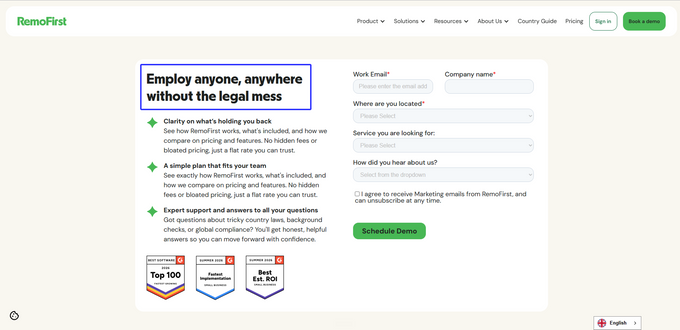
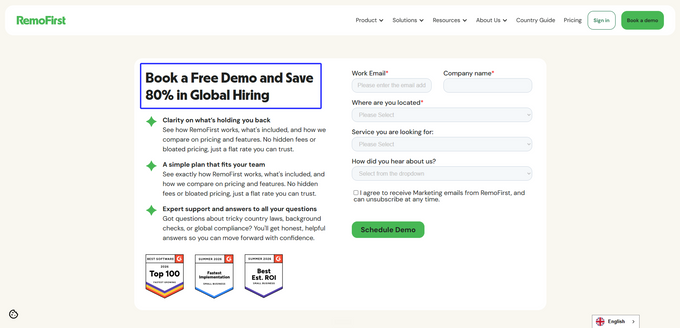
On its demo request page, global hiring platform RemoFirst worked with CROforce to test its headline against a version that led with a specific, concrete offer. The original read "Employ anyone, anywhere without the legal mess."
The variant, "Book a Free Demo and Save 80% in Global Hiring," lifted conversion rate by 15.9%.
Control:
Variant:
What to test in your headline
- Leading with the strongest, most concrete benefit rather than a generic brand statement
- Keeping the message short enough to scan in a glance
- Leading with a specific number or outcome, like a percentage saved, rather than an abstract promise
CTA button
Wording, color, size, and placement all affect whether a visitor notices and clicks it, making this one of the highest-leverage, lowest-effort elements to test.
CTA button A/B testing example
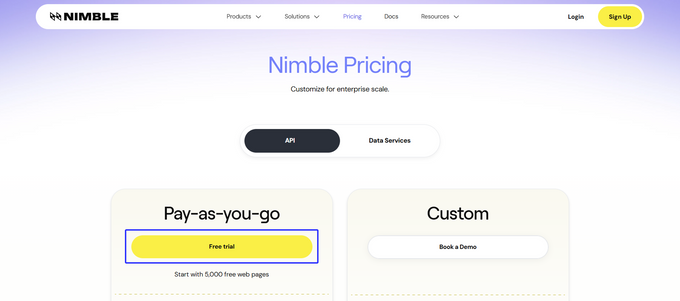
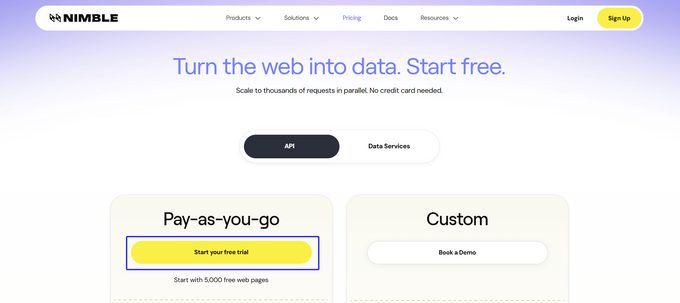
For web data platform Nimble, we tested a pricing page CTA change: swapping "Free trial" for the more specific "Start your free trial," expecting the new version to win. Instead, conversion rate dropped by 23.3%.
That's still a useful result, since it shows the "better" wording didn't actually perform better here.
Control:
Variant:
What to test on your CTA button
- Wording that implies a specific benefit rather than a generic action
- How much it stands out from the rest of the page
- Where it sits relative to the fold
Form fields
Every field on a form is a small piece of friction: something to read, decide on, and type before a visitor can convert. Cutting fields usually removes that friction and lifts completion rates, though not always.
More fields can sometimes pre-qualify leads earlier, or signal that what's on offer is worth a bit of extra effort, so it's worth testing in both directions rather than assuming shorter always wins.
Form field A/B testing example
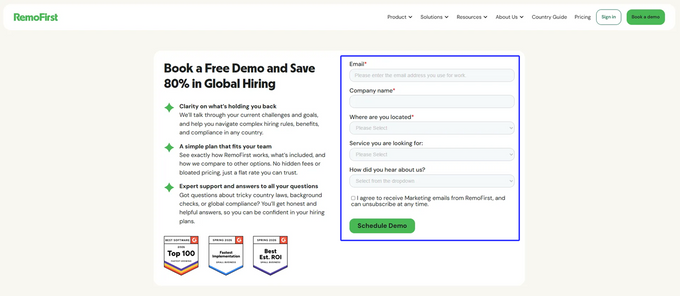
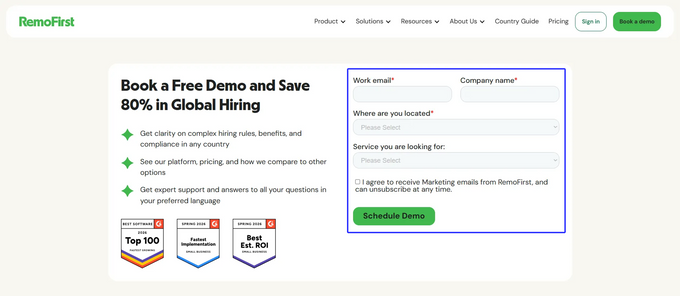
In a CROforce-run test, RemoFirst tried a shorter version of its demo request page. It cut a field asking how visitors heard about the company and trimmed three benefit descriptions down to short one-line bullets. The shorter version increased conversion rate by 23.1%.
Control:
Variant:
What to test in your form
- Field count in both directions, not just fewer
- Field order
- Whether inline validation reduces abandonment
Trust signals and social proof
Testimonials, badges, and press mentions build credibility, but their placement and format matter as much as whether they're present at all.
Social proof A/B testing example
For kGoal, we tested adding a star rating directly under the product title on a product page, alongside a fuller image gallery and clearer product title placement. The variant lifted conversion rate by 27.1% and revenue per visitor by 26.8%.
Control:

Variant:

What to test with your trust signals
- Star ratings or review counts near the price versus lower on the page
- Testimonials as written quotes versus video
- Specific, named results versus generic praise
Page layout
Reordering sections, rather than redesigning them, can reveal whether visitors are seeing your strongest argument before they lose interest.
Page layout A/B testing example
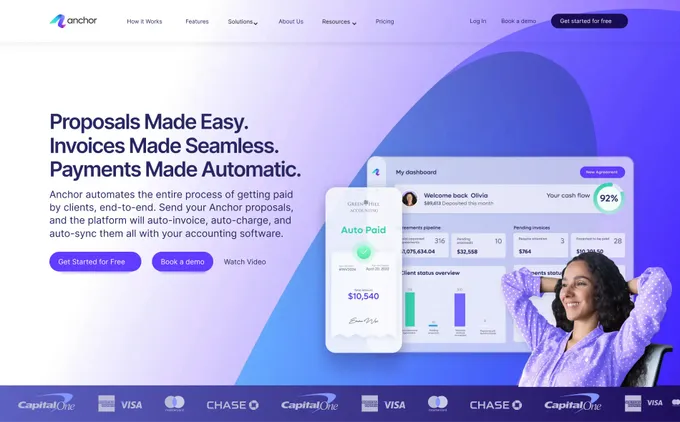
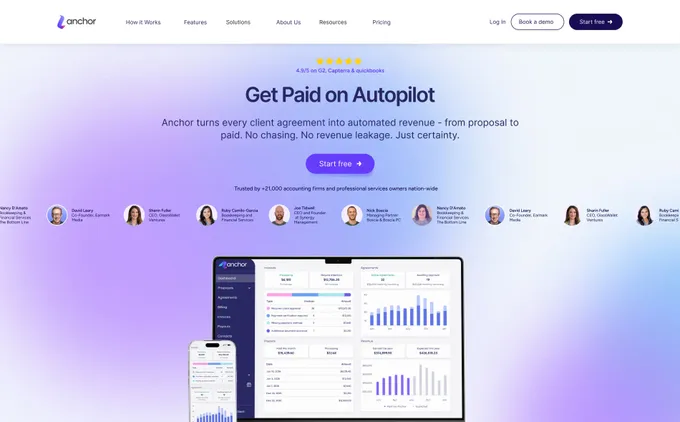
For billing automation platform Anchor, we tested a centered, benefit-led homepage layout against the original left-aligned version. We added a star rating, social proof, and a new hero image.
The variant lifted conversion rate by 62.7% and revenue per visitor by 62.9%.
Control:
Variant:
What to test in your page layout
- Centered versus left-aligned hero content
- Adding social proof, like ratings or trust lines, above the fold
- Photo-based versus product or dashboard imagery in the hero
How much traffic you need and what to do if you don't have it
Before testing a page, check whether it gets enough traffic to make a test worthwhile in the first place. As a rule of thumb, a page needs enough visitors each month to collect around 1,000 per variant within a few weeks.
That's the volume most tests need to reach a statistically significant result at a 95% confidence level. A page getting a few hundred visitors a month will take months to get there, which is often too slow to be worth running as a live test.
- Measure a step higher in the funnel: If you don't have enough conversions to test against directly, measure clicks or another earlier action in the funnel instead, then move to conversions once you have enough volume.
- Extend the test rather than abandon it: A low-traffic page that runs for six weeks can collect the same sample size as a high-traffic page running for one week, so a longer runtime is often a better fix than giving up on the test.
- Avoid splitting traffic further: Segmenting an already-small sample by device or channel just divides it further and adds noise, making it harder to reach a trustworthy result.
» Does your landing page get enough traffic to test properly? Talk to a CRO expert to find out
How to run a landing page test from hypothesis to rollout
Step 1: Define your goal
Revenue per visitor is the ideal target, since it accounts for both conversion rate and the value of what converts. If you don't have enough data for that yet, conversion rate or even a proxy metric like clicks works as a starting point.
Step 2: Form a specific hypothesis
State clearly what you're changing and what you expect it to do, for example: "Changing the headline to lead with a single benefit will increase form completions." A specific hypothesis makes the result easier to interpret afterward, since you're checking it against a stated expectation rather than reading the outcome after the fact.
Step 3: Build the variant
Change only the one element the hypothesis is about. That one change can still be a bigger swing on a landing page than you'd attempt on a homepage, since there's less brand risk at stake.
Step 4: Split traffic
Randomize the split evenly between the control and the variant using an A/B split test, so each group fairly represents your overall audience. Most testing tools handle this automatically and keep each visitor on the same version for the full test, so returning visitors don't see a different page each time.
Step 5: Run the test to statistical significance
Don't call the test early, even with an encouraging lead, until you've reached the visitor threshold covered earlier. Let it run through full weekly cycles too, since traffic and behavior often look noticeably different on weekdays versus weekends.
Step 6: Analyze the results
Check the results in this order:
- Significance first: Confirm the test reached a trustworthy sample size before reading anything else into it.
- The metric behind your original goal: Revenue per visitor, conversion rate, or whatever proxy metric you set out to move.
- Why the winner won: This understanding shapes better hypotheses for the next test.
- Traffic source quality: Compare conversion rate by source using UTM parameters. These are short tags added to the end of a URL, like
utm_source=facebook, that tell you which channel sent the visitor. A variant can look like a clear win overall while converting your best channel, like Google, worse than before.
An inconclusive result isn't a failure either. It still tells you the change didn't move things as much as expected, which is useful for planning the next test.
» See the best A/B testing tools that handle the traffic split and analysis for you
Common landing page testing mistakes
- Testing too many things at once: Changing several elements in one variant makes it impossible to know which change actually drove the result.
- Calling the test too early: Ending a test before it reaches a trustworthy sample size risks acting on noise rather than a real signal.
- Testing low-traffic or low-value pages: Time spent testing a page far from any leverage point is time not spent on a page that could actually move the needle.
- Ignoring what past tests already taught you: Repeating an idea that already failed wastes a test cycle that could have explored something new.
- Changing something else mid-test: Adjusting ad creative, pricing, or other page elements while a test is running can quietly skew the result.
» Want to avoid these mistakes altogether? See the most common A/B testing mistakes
Bottom line on landing page A/B testing
Always test a landing page change rather than assume it will help. Prioritize the pages and elements where traffic, conversions, and revenue overlap, since that's where a test can actually move the needle.
This is also where a managed team can help.
If you can only run one or two tests a month, and the ideas aren't based on real experience, most of those tests are going to fail.
Tom Amitay , CEO at CROforce
Most businesses are also limited by design and development capacity. This keeps them stuck testing small, low-risk changes like button colors. CROforce's team runs full page redesigns as tests, not just minor tweaks, bringing both the experience to prioritize better ideas and the capacity to test bigger ones.
» Ready to see how a managed landing page test works? Book a demo with CROforce
FAQs
What is landing page A/B testing?
It's a controlled experiment that shows two versions of a landing page, a control and a variant with one change, to different visitors to see which one converts better.
How much traffic do I need to A/B test a landing page?
As a rough guide, aim for around 1,000 visitors per variant before trusting the result. Below that, extend the test runtime or measure an earlier step in the funnel instead.
What should I do if my landing page doesn't get enough traffic?
Measure a proxy metric like clicks instead of the final conversion, run the test longer rather than adding more variants, and avoid splitting the traffic further by device or channel.
Which landing page elements should I test first?
Headlines and CTA buttons tend to have the biggest impact, since they sit above the fold where visitors spend the most attention. Form fields, trust signals, and page layout are worth testing next.
How do I know if a winning variant is bringing in better quality leads?
Compare conversion rate by traffic source using UTM parameters, tags added to a URL (like utm_source=facebook) that show which channel sent the visitor. A variant can win overall while quietly converting your best traffic sources worse than before.